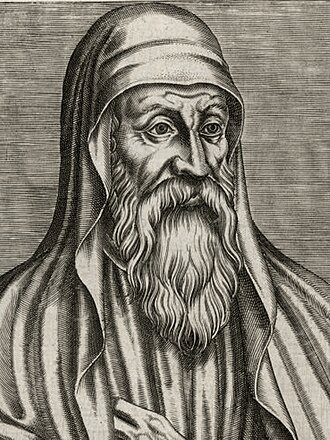
Origen
184–254 · Early Christian theologian and scholar of Alexandria
Origen of Alexandria (c. 184–c. 253) was an early Christian theologian, scholar and ascetic, and one of the most influential figures of the church in its first centuries. He was born and spent the first half of his career in Alexandria, where Greek learning was deeply rooted, and his work shaped how eastern Christianity thought about scripture, philosophy and doctrine. He is counted among the church fathers, although his reputation became contested after his death.
According to the tradition preserved by Eusebius of Caesarea, his father Leonides, a teacher of literature and an openly practising Christian, was beheaded during Septimius Severus's persecution in 202, when Origen was still a teenager. His mother prevented him from surrendering to the authorities. With the family left impoverished, he was appointed catechist at the Catechetical School of Alexandria at eighteen. Scholars doubt that he ever led the school, and think he more likely held a paid teaching post. He lived with great austerity: he went barefoot, owned a single cloak, abstained from wine and meat, and fasted often. He studied philosophy in several schools in the city, including the Platonic circle of Ammonius Saccas. Later, the patronage of Ambrose, a wealthy former follower of Valentinian Gnosticism who converted to orthodox Christianity, gave him secretaries and copyists, which allowed him to produce an enormous body of work, estimated at around two thousand treatises.
Among his major works are On First Principles, a systematic attempt to set out Christian doctrine that shaped later theologians; Contra Celsum, a defence of Christianity against the pagan philosopher Celsus and perhaps the most influential piece of early Christian apologetics; and the Hexapla, an edition of the Hebrew Bible that placed the Hebrew text beside several Greek translations in parallel columns. He also wrote hundreds of homilies and biblical commentaries, many of which read Scripture allegorically.
His central ideas blend Platonic philosophy with Christian faith. He taught that God first created the souls of all rational beings, which turned away from him and were then given material bodies; the physical world, in this view, follows from that fall rather than being its starting point. He hoped that all might eventually be saved, though he always presented this as speculation rather than settled doctrine. He defended free will, advocated Christian pacifism, and developed an early version of the ransom theory of atonement. His thinking on the Trinity was subordinationist, though it helped prepare the later formulation of the doctrine.
His influence was especially strong in the East, where Athanasius of Alexandria and the three Cappadocian Fathers counted among his devoted followers. His teachings also provoked controversy: the first Origenist crisis broke out in the late fourth century, and in 543 Emperor Justinian I condemned him as a heretic and ordered his writings burned. The church rejected his doctrine of the pre-existence of souls, but his allegorical method and his way of thinking about faith remained present in later theology.
Key ideas
- Pre-existence of souls: before the material world, all rational beings existed alongside God and later turned away from him.
- Free will: human will is free and responsible for its actions, even on the path toward God.
- Allegorical exegesis: many passages of Scripture should be read in a spiritual sense as well as a literal one.
- Hope for universal salvation: Origen hoped all would be saved, but offered this only as speculation.
- Ransom theory: Christ's atonement is understood as a price paid to free humanity from captivity.
Books to read
- The writings of Origen, Vol. 1 (of 2) EnglishEPUB 549 KBRead online
- The writings of Origen, Vol. 2 (of 2) EnglishEPUB 774 KBRead online
Curiosities
The Hexapla
He arranged the Hebrew text of the Bible and several Greek translations in parallel columns, which gave the work its name.
A generous patron
Ambrose provided him with secretaries, stenographers and copyists, which made his prolific output possible.
Teachers and influences
Teachers
- Clement of Alexandria 150–215
- Hippolytus 170–235
Influenced
- Pierre Teilhard de Chardin 1881–1955
Original Filopedia text based on Wikipedia (es) and Wikipedia (en) and Wikidata.