Hippolytus
170–235 · Early Christian writer of ancient Rome
Hippolytus of Rome (c. 170-235) was one of the most important Christian thinkers of the second and third centuries. He wrote in Greek, and his origins, his exact identity and the full extent of his work remain hard to pin down. Rome, Palestine, Egypt and Anatolia have all been proposed as his community. He matters both for what he wrote and for the legends that gathered around his name over the centuries.
He served as a presbyter in the Church of Rome during the time of Bishop Zephyrinus, and was known for his learning and his skill as a speaker. Photios claims he was a pupil of Irenaeus of Lyon, though this is uncertain. The young Origen is said to have heard his sermons around this period. Hippolytus criticised Zephyrinus for tolerating modalist views, and Callixtus I for readmitting Christians who had committed serious sins. The dispute ended in a schism. For about a decade he led a separate congregation, and some sources describe him as a rival bishop of Rome elected in 217, which is why he is often called the first antipope.
In 235, during the persecution under Maximinus Thrax, Hippolytus and Pope Pontian were exiled to Sardinia, where both died. A document known as the Liberian Catalogue records that their bodies were buried in Rome on 13 August, probably in 236, and that Hippolytus was remembered as a priest and martyr. This suggests he had been reconciled with the Church before his death. He is venerated as a saint, and he is the only antipope canonised by the Catholic Church.
His output was wide-ranging, covering exegesis, homiletics, apologetics and polemic, chronography and canon law. It survives only in fragments, which makes it hard to judge his intellectual weight with confidence. His biblical commentaries are admired for their restraint, although some of his typological readings are loose. The Refutation of All Heresies is his best-known work, though its authorship is disputed. His Chronicle, running from creation to the year 234, became a model for many later chronological works.
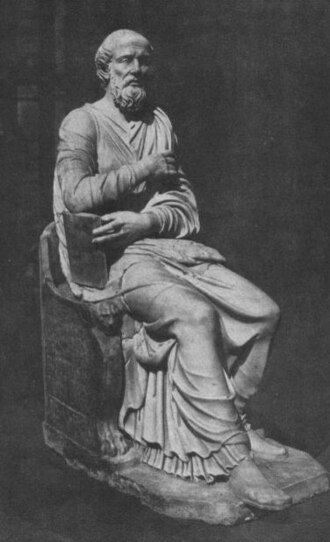
His biography remains contested. After a Roman congress in 1976 scholars proposed separating a Western and an Eastern author, but the question is still open. A marble statue found in 1551 near the Via Tiburtina, bearing the titles of his writings, remains a key piece of evidence, though doubts persist about its origins and its later restorations.
In the Middle Ages he was confused with a soldier converted by Saint Lawrence and with another martyr of the same name. In the fifth century Prudentius linked his death to the myth of Hippolytus, dragged by horses, and this helped make him a patron of horses. His more lasting legacy lies in chronology and church law, where his influence reached both East and West.
Key works
- Commentary on the Prophet Daniel, one of the best-preserved works, containing the earliest known reference to celebrating the birth of Jesus on 25 December.
- Treatise on the Antichrist, written around 202, which vividly describes the events expected before the end of the world.
- Commentary on the Song of Songs, the earliest surviving Christian interpretation of this book, tied to instruction for new Christians.
- Refutation of All Heresies, a polemical work in ten books, also known as the Philosophumena, whose authorship is disputed.
- Chronicle, a compilation of world history from creation to the year 234.
Books to read
- Philosophumena; or, The refutation of all heresies, Volume I EnglishEPUB 466 KBRead online
- The Apostolic Tradition of Hippolytus Translated into English with Introduction and Notes EnglishGutenberg
Curiosities
Patron of horses
According to tradition, Prudentius linked the saint's death to the Greek myth of Hippolytus, dragged to death by his horses. This is why he came to be regarded as a patron of horses, and in the Middle Ages sick horses were brought to a church dedicated to him in Hertfordshire.
A statue listing his works
In 1551 a marble statue was reportedly found in a cemetery on the Via Tiburtina, with the titles of his writings carved on it. It was heavily restored, and it is now in the Lateran Museum, though its original form and purpose remain unclear.
Teachers and influences
Teachers
- Irenaeus 130–202
Pupils
- Origen 184–254
Original Filopedia text based on Wikipedia (es) and Wikipedia (en) and Wikidata.