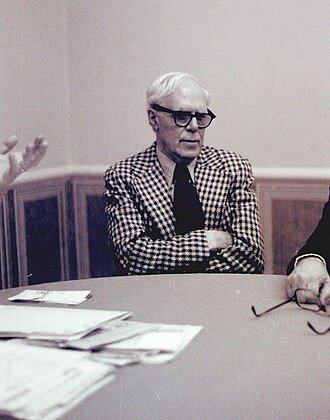
Martin Gardner
1914–2010 · American popularizer of recreational mathematics and scientific skepticism
Martin Gardner (Tulsa, Oklahoma, 1914 - Norman, Oklahoma, 2010) was an American writer who devoted his career to popularizing recreational mathematics and skeptical thinking. He is mostly remembered for mathematics, but his work also ranged across magic, philosophy, religion, and literature. His importance lies in how many readers he drew toward formal ideas who might otherwise never have come near them.
He was born into a comfortable family in Tulsa. His mother, a teacher trained in the Montessori method, taught him to read before he started school, and hearing The Wizard of Oz read aloud began a lifelong fascination with L. Frank Baum's Oz books. As a boy he received from his father, a petroleum geologist, a copy of Sam Loyd's puzzle collection, which sparked his interest in mathematics. He studied at the University of Chicago and earned a degree in philosophy in 1936. During the Second World War he served four years in the U.S. Navy.
After the war he settled in New York and worked as an editor at the children's magazine Humpty Dumpty, where his paper-folding puzzles led him to Scientific American. In 1952 he published In the Name of Science, a sharp survey of fads and of charlatans posing as scientists, now regarded as a founding text of the skeptical movement. In 1957 he began his "Mathematical Games" column in the same magazine, which he wrote for roughly twenty-five years and which introduced many readers to flexagons, the Game of Life, and pentominoes.
Gardner never took a mathematics course after high school, and his approach stayed that of an enthusiastic explainer rather than a formal prover. He believed that games and paradoxes could open the door to rigorous reasoning, and that good popularization makes truths accessible without distorting them. His skepticism drew a line between open scientific inquiry and extraordinary claims offered without evidence. In 1976 he helped found CSICOP, an organization devoted to examining such claims with reason.
His most successful book was The Annotated Alice, which combined Lewis Carroll's two Alice books with notes and sold more than a million copies. He wrote over a hundred books and contributed regularly to The New York Review of Books.
He left Scientific American in 1979 and moved to North Carolina, returning to Oklahoma in 2004, where he died in 2010. His autobiography, Undiluted Hocus-Pocus, was published after his death. His influence lies in the many mathematicians, scientists, and computer scientists who first caught their interest through his columns, and Donald Knuth called his collected books the canonical ones.
Key ideas
- Recreational mathematics: games, puzzles, and paradoxes can serve as a gateway to serious mathematical ideas.
- Rational skepticism: extraordinary claims should be tested with evidence and method, not accepted on belief.
- Rigorous popularization: explaining complex ideas without falsely simplifying them and without losing a sense of wonder.
Where to start
Fads and Fallacies in the Name of Science 1957
Modas y falacias en nombre de la ciencia is an accessible gateway to Gardner's critical thinking. It gathers popular essays examining pseudosciences, miracle cures and fringe theories with irony and rigour, teaching the reader to tell genuine science from its imitations. No prior training is required.
Next: The Ambidextrous Universe. Left and Right in the Cosmos is a good next step, as it turns his sceptical, curious eye toward symmetry, a theme running through mathematics, art and cosmology.
Works in Filopedia
Curiosities
The flexagons
In 1956 the magician Royal Vale Heath showed him flexagons and put him in touch with four Princeton professors who had studied their mathematical properties.
His favorite puzzle
When his son Jim asked him for his favorite puzzle, he answered almost immediately: "The monkey and the coconuts".
Escher and Gardner
In 1961 Gardner wrote to M. C. Escher asking permission to use one of his tessellations in a column, and the correspondence that followed helped spread the artist's work.
Original Filopedia text based on Wikipedia (es) and Wikipedia (en) and Wikidata.