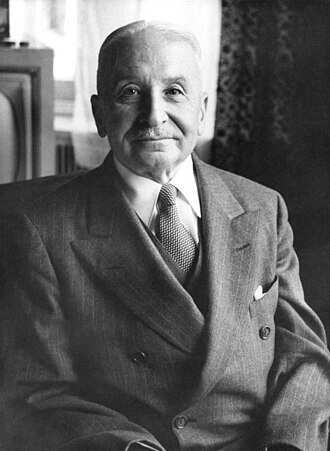
Ludwig von Mises
1881–1973 · Austrian economist and philosopher, a central figure of the Austrian School
Ludwig von Mises (1881–1973) was an Austrian-born economist and philosopher, one of the central figures of the Austrian School and a leading defender of classical liberalism in the twentieth century. He is best known for praxeology, the deductive method he proposed for studying human action, and for his comparisons of communism and capitalism.
Born in Lemberg, then the capital of Galicia in Austria-Hungary and today part of Ukraine, Mises came from a family of railway engineers that had recently been ennobled. He studied law and social sciences at the University of Vienna. At first he worked within the historical tradition of public administration, but after reading Carl Menger's Principles of Economics in 1903 he turned toward theory. He trained in the seminar of Eugen von Böhm-Bawerk and in 1909 joined the Vienna Chamber of Commerce and Industry, where he stayed for twenty-five years and shaped Austrian economic debate.
His early work carried Menger's subjective theory of value into the study of money. The Theory of Money and Credit (1912) argued that booms and slumps were fed by credit expansion and misallocated resources, and that changes in the money supply were never neutral. After the First World War, Socialism (1922) contended that a collectively run economy lacked the price system needed to judge what to produce and how to use scarce resources. He opposed so-called third ways between market and state and regarded economics as an a priori discipline, closer to logic than to laboratory science.
In 1934 he left Austria for Geneva, and in 1940 he fled Europe for the United States, where he became a citizen in 1946 and taught as a visiting professor at New York University until 1969. There he published Human Action in 1949, his major treatise, which presents market order as the coordination of countless individual decisions.
His influence reached far beyond his books. His students included Friedrich Hayek, Murray Rothbard and Israel Kirzner, and his private seminar in Vienna trained generations of economists. Libertarian and classical liberal movements drew heavily on his writings. He died in New York in 1973.
Key ideas
- Praxeology: a deductive, a priori method for understanding human action, closer to logic or geometry than to laboratory experiment.
- Economic calculation: without market prices, a socialist economy cannot rationally judge what to produce or how to allocate its resources.
- Non-neutral money: changes in the money supply shift relative prices, redistribute wealth and fuel cycles of boom and bust.
- Classical liberalism: market order emerges from the rational action of individuals, and state intervention tends to backfire.
Works in Filopedia
Books to read
- Die Entwicklung des gutsherrlich-bäuerlichen Verhältnisses in Galizien (1772-1848) GermanGutenberg
Curiosities
A renewed doctorate
In 1956, the University of Vienna marked the 50th anniversary of his doctorate and renewed it, a European tradition.
Papers recovered
On the day German forces entered Vienna during the Anschluss, they raided his apartment and seized his papers and library. They were long believed lost until Richard Ebeling and his wife Anna found them decades later in Soviet archives in Moscow.
Praise for Poland
He praised the Polish victory over the Bolsheviks at the Battle of Warsaw in 1920, which he described as a defence of Western civilization against Eastern despotism.
Teachers and influences
Pupils
- Friedrich Hayek 1899–1992
- Murray Rothbard 1926–1995
Influenced
- Ayn Rand 1905–1982
- Hans-Hermann Hoppe b. 1949
Original Filopedia text based on Wikipedia (es) and Wikipedia (en) and Wikidata.