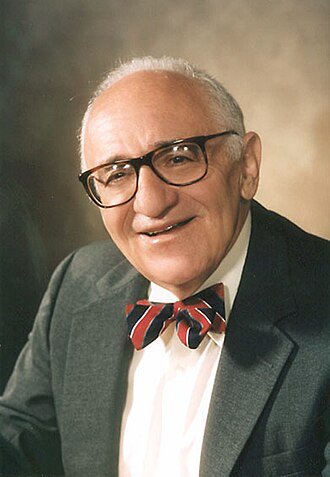
Murray Rothbard
1926–1995 · American economist, historian and political theorist, founder of anarcho-capitalism
Murray Newton Rothbard (born in the Bronx in 1926, died in New York in 1995) was an American economist of the Austrian School, economic historian and political theorist. A central figure of the American libertarian movement, especially its right-wing strand, he is regarded as the founder and leading theoretician of anarcho-capitalism. His importance lies in pushing the defence of private property and free markets against the state to its most radical conclusions.
The son of Jewish immigrants, he studied at Columbia University, where he earned a degree in mathematics in 1945 and a doctorate in economics in 1956, a delay caused partly by friction with his adviser, Joseph Dorfman. In the 1950s he attended the informal seminar of Ludwig von Mises and received financial support from the William Volker Fund, which paid him for a decade to write. That work grew into Man, Economy, and State (1962), his most ambitious book, which Mises praised warmly. He later taught at the Brooklyn Polytechnic Institute and, from 1986, at the University of Nevada, Las Vegas. He wrote more than twenty books, and his output was legendary: the economist Walter Block said he could write at an average of eight pages an hour.
In philosophy, Rothbard started from self-ownership and natural rights. In The Ethics of Liberty he argued that original appropriation through labour is legitimate, that voluntary exchange should be free, and that forced redistribution of property titles is illegitimate. From this he concluded that the state should be abolished, which he described as organised robbery. His opposition to fractional-reserve banking and central banks came from the same logic. His method, inherited from Mises, was apriorist: the laws of human action are deduced by reasoning before being tested against empirical data.
His political path changed over time. In the 1960s he drew closer to the New Left and the movement against the Vietnam War; in the 1980s he criticised Ronald Reagan's government and later moved towards paleoconservatism, which he called paleolibertarianism. His views on equality, civil rights and historical revisionism drew harsh criticism. His influence endures in the libertarian movement and in the Mises Institute he helped found, and in recent years he has also been cited as a reference point for parts of the alt-right.
Key ideas
- Self-ownership: the foundation of all rights is that each person owns themselves and what they legitimately obtain through their labour.
- Non-aggression principle: no one may initiate force against another, which leads him to reject taxation and state intervention.
- Anarcho-capitalism: services the state now provides, such as justice and security, could be delivered more efficiently by the market.
- Opposition to banking privilege: fractional-reserve banking and central banks are, in his view, a form of fraud that should be abolished.
Curiosities
A Republican student
In 1948, while a student at Columbia, he organised a group supporting Strom Thurmond because of his defence of states' rights. By his own recollection, he was one of only two Republicans on campus.
Eight pages an hour
The economist Walter Block, a friend and follower, said Rothbard could write at an average pace of eight pages an hour.
A law bearing his name
Rothbard's Law is a saying he attributed to himself: each person specialises in what he is worst at.
Teachers and influences
Pupils
- Hans-Hermann Hoppe b. 1949
Influenced
- Hans-Hermann Hoppe b. 1949
Original Filopedia text based on Wikipedia (es) and Wikipedia (en) and Wikidata.