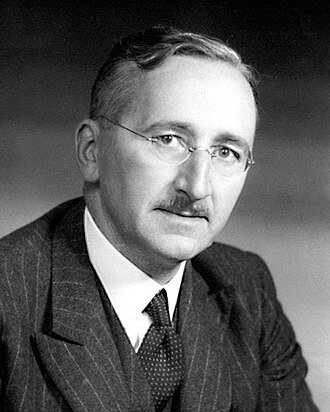
Friedrich Hayek
1899–1992 · Austrian economist and philosopher, a central figure of the Austrian School
Origins and family
Friedrich August von Hayek was born in Vienna on 8 May 1899 into a family of intellectuals. His father, August von Hayek, was a physician employed by the municipal health authority and a part-time botany lecturer at the University of Vienna. His paternal grandfather taught natural sciences and wrote on biological systematics, while his maternal grandfather, Franz von Juraschek, was an economist and a close friend of Eugen von Böhm-Bawerk. On his mother's side he was a second cousin of the philosopher Ludwig Wittgenstein. Hayek met Wittgenstein only a few times, but he said that Wittgenstein's philosophy and methods of analysis had a profound influence on his own thought.
The surname derives from the Czech Hájek and traces back to an ancestor who migrated from Prague in the sixteenth century. Hayek had two younger brothers, Heinrich and Erich. As a teenager he showed a strong interest in biology and theatre, but he was an indifferent pupil, failing Latin, Greek and mathematics at one point. He read works on genetics and evolution and the philosophy of Feuerbach, and was drawn to a teacher's lectures on Aristotle's ethics.
War and university training
In 1917 he joined an artillery regiment of the Austro-Hungarian army and fought on the Italian front. He lost hearing in his left ear and was decorated for bravery. He later said that this experience was the decisive reason he turned to the social sciences, wishing to help avoid the mistakes that had led to the war.
After the war he studied at the University of Vienna, initially concentrating on philosophy, psychology and economics, with the aim of combining law and economics for a diplomatic career. He earned doctorates in law in 1921 and in political science in 1923. For a short period, while the university was closed, he worked in Constantin von Monakow's Institute of Brain Anatomy. This experience inspired an early psychological project that was eventually published in 1952 as The Sensory Order. He also took part in a private seminar, the Geistkreis, which he founded with Herbert Furth, and he was influenced by Carl Menger and by Friedrich von Wieser.
Early career and the encounter with Mises
On Wieser's recommendation, Ludwig von Mises hired Hayek after his examinations as a specialist on the legal and economic details of the Treaty of Saint-Germain for the Austrian government. Between 1923 and 1924 he worked as a research assistant to Professor Jeremiah Jenks at New York University, compiling macroeconomic data on the American economy and the Federal Reserve. His time in America was lonely and financially difficult.
Hayek began as a mild socialist, sympathetic to Wieser's democratic socialism, but he moved away from it after reading Mises's book Socialism, which impressed him deeply. He began attending Mises's private seminars, where he met Fritz Machlup, Alfred Schutz, Felix Kaufmann and Gottfried Haberler, and he became friends with the political philosopher Eric Voegelin. With Mises's help he founded and directed the Austrian Institute for Business Cycle Research.
London and the debate with Keynes
In 1931, at the invitation of Lionel Robbins, he joined the London School of Economics, where he was quickly recognised as one of the leading economic theorists in the world. That year he published Prices and Production, based on his lectures there. In it he argued that the business cycle arose from credit expansion by the central bank and artificially low interest rates, which encouraged investment in projects that could only survive on cheap money. His theory clashed sharply with that of John Maynard Keynes, who called the book "one of the most frightful muddles I have ever read". Piero Sraffa responded on Keynes's behalf, and the controversy generated a large number of replies. However, after the publication of Keynes's General Theory in 1936, Keynesian ideas gained the upper hand and Hayek's position lost ground.
Hayek and his children became British subjects in 1938. During these years he published work on the coordinating role of prices, the dispersed nature of knowledge in society, and the impossibility of rational economic calculation under central planning.
The Road to Serfdom and Chicago
In 1944 he published The Road to Serfdom, written in response to the widespread British view that fascism was a capitalist reaction against socialism. He argued that Nazism, fascism and state socialism shared common roots in central economic planning and in the power of the state over the individual. The book was a considerable success, especially in the United States, where the University of Chicago published it and Reader's Digest printed an abridged version, giving it a readership far beyond academia.
In 1950 he left the London School of Economics and joined the University of Chicago's Committee on Social Thought, with a salary funded by an outside foundation, the William Volker Fund. There he worked alongside Milton Friedman and George Stigler and helped found the Mont Pèlerin Society. Although he shared most political views with Friedman, their disagreements over monetary policy and their work in different departments prevented a close collaboration.
In Chicago he published The Constitution of Liberty (1960), which he regarded as his major philosophical work on liberty, though it received a disappointing reception. He left Chicago largely for financial reasons.
Freiburg, Salzburg and the Nobel Prize
From 1962 to 1968 he was a professor at the University of Freiburg in West Germany, where he worked on Law, Legislation and Liberty, published in three volumes between 1973 and 1979. He then taught at the University of Salzburg from 1969 to 1977, a period he later regretted because of the limited resources and his health problems. In 1974 he shared the Sveriges Riksbank Prize in Economic Sciences in Memory of Alfred Nobel with Gunnar Myrdal, for his work on monetary theory, economic fluctuations and the interdependence of economic, social and institutional phenomena. The prize brought him renewed public attention and a new burst of activity.
Political influence and final years
In the 1980s his ideas had an influence on the government of Margaret Thatcher, who received him and cited him as a reference, and on the presidency of Ronald Reagan, who considered him one of the two or three people who most shaped his philosophy. He was made a Member of the Order of the Companions of Honour in 1984 and received the Presidential Medal of Freedom from George H. W. Bush in 1991.
His personal life included two marriages; the second, to Helene Bitterlich in 1950, caused a scandal at the LSE and estranged him from some colleagues. Hayek died in Freiburg on 23 March 1992 and was buried in the Neustift am Walde cemetery in Vienna.
Legacy
His work spans economics, philosophy of science, psychology, political theory and law. His most debated technical contribution, the Austrian theory of the business cycle, was poorly received in his lifetime, though his work on dispersed knowledge and prices as a system of information became central references in modern economics. His defence of spontaneous order, the rule of law and free markets has had a major influence on the neoliberal movement, though it has also drawn criticism for its implications and for some of his more controversial political positions.
Key ideas
- Spontaneous order: societies coordinate best through rules and interactions that no one designs in full, such as markets or language.
- Dispersed knowledge: the information that matters for the economy is spread across millions of people, and only free prices transmit it effectively.
- The danger of planning: centralised control of the economy, however well intended, tends to reduce freedom and concentrate political power.
- Austrian business cycle theory: credit expansions can distort the productive structure and trigger later crises.
Quotes
“Personally I prefer a liberal dictatorship to a democratic government devoid of liberalism.”
Entrevista a El Mercurio
Where to start
The Road to Serfdom 1944
The Road to Serfdom is a short, accessible essay written during World War II. Hayek warns how centralized economic planning can erode individual freedom and lead toward totalitarianism. Readers will find clear arguments about the link between state power, the economy, and personal rights, with no technical background required.
Next: The Constitution of Liberty. The Constitution of Liberty expands on the ideas of The Road to Serfdom, developing in greater detail his defense of the liberal order and the rule of law.
Works in Filopedia
Curiosities
A family link to Wittgenstein
On his mother's side, Hayek was a relative of the philosopher Ludwig Wittgenstein, and he was among the first to read the Tractatus after its publication in 1921.
A controversial letter
In 1983, shortly after the Falklands War, he wrote a letter to The Times suggesting that Buenos Aires be attacked before Argentina could press its claim to the islands.
Teachers and influences
Influenced
- Mario Vargas Llosa 1936–2025
Original Filopedia text based on Wikipedia (es) and Wikipedia (en) and Wikidata.