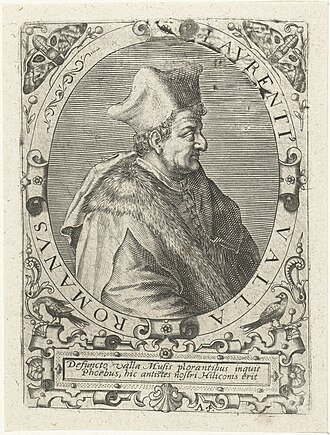
Lorenzo Valla
1407–1457 · Italian humanist, philologist and critic of the Donation of Constantine
Lorenzo Valla (Rome, 1406 or 1407 – Rome, 1 August 1457) was an Italian humanist who worked as a rhetorician, teacher and philosopher, and who is often regarded as a pioneer of modern historical and philological criticism. He lived during the Renaissance, when humanists sought to recover ancient texts and clear them of the errors that had accumulated over the Middle Ages. His name is tied above all to a demonstration that caused a stir in his own time: the document known as the Donation of Constantine, which the papacy used to claim large territories in the West, was a forgery.
His family came from Piacenza, and his father, Luca della Valla, was a lawyer. Valla studied Latin with Leonardo Bruni and Greek with Giovanni Aurispa, and he is thought to have been largely self-taught in other areas. He was ordained a priest in 1431, and that same year he unsuccessfully sought a post as apostolic secretary. He then taught eloquence at the University of Pavia, but his attack on the Latin style of the jurist Bartolus of Saxoferrato made him enemies and forced him to leave. After that he moved from one university to another. Between 1435 and 1445 he served at the court of Alfonso V of Aragon in Naples, where he wrote much of his philological work. Around 1447 Pope Nicholas V invited him to Rome to translate Greek texts into Latin, and he ended his days there as a papal scribe and, in 1455, papal secretary.
His best-known work is the treatise on the Donation of Constantine, written around 1439–1440. Valla argued that the document's language belonged to the eighth century rather than the fourth, pointed to anachronisms such as the word "satrap", and held that Constantine could not legally have granted such powers. In biblical scholarship he worked from the Greek of the New Testament and questioned the Vulgate's rendering of the Greek metanoia as paenitentia, which he thought should mean "repentance" rather than "penance", a point that undermined the church's system of penance and indulgences. His Elegantiae of the Latin language offered a rigorous grammar and a model of classical Latin. In philosophy, his early dialogue De voluptate showed an Epicurean leaning that he later revised in De vero bono, and his Dialectical Disputations aimed to clarify and rationalise Aristotelian logic as taught in the scholastic tradition.
Valla was a combative polemicist, and he was once put on trial for heresy after a dispute over the Apostles' Creed. His influence was considerable. Erasmus regarded him as an indispensable guide to Latin grammar, Martin Luther held him in high esteem, and Robert Bellarmine called him "Luther's precursor". His methods of textual criticism anticipated much later philological work.
Key ideas
- Documentary criticism: the internal analysis of a text's language and anachronisms can show that its date or authorship is false.
- Latin as a living and measured language: correct Latin requires studying classical authors rather than relying on medieval grammars.
- Biblical philology: returning to the Greek original allows translations with doctrinal consequences to be corrected, as with the word "penance".
- Simplified logic: dialectic should rest clearly and rationally on Aristotle, without the sterile complexity of late scholasticism.
- Pleasure and persuasion: in De voluptate, pleasure and the way a speaker wins over the listener are central to rhetoric.
Books to read
- The treatise of Lorenzo Valla on the Donation of Constantine EnglishEPUB 286 KBRead online
Curiosities
A document examined closely
Valla showed that the Latin of the Donation of Constantine was poor and that the text switched verb tenses without good reason.
A vanished tomb
His tomb and epitaph, beside the monumental bronze Lex de imperio Vespasiani at Saint John Lateran, were destroyed in 1576 on the orders of Pope Gregory XIII, a staunch believer in the Donation.
Teachers and influences
Teachers
- Leonardo Bruni 1369–1444
Original Filopedia text based on Wikipedia (es) and Wikipedia (en) and Wikidata.