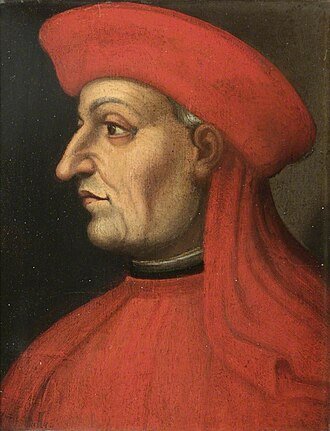
Leonardo Bruni
1369–1444 · Italian humanist, historian and statesman
Leonardo Bruni (Arezzo, c. 1369-1370 – Florence, 9 March 1444) was an Italian humanist, historian and statesman. He is often regarded as the most important humanist historian of the early Renaissance and, because of the way he divided the past, one of the first modern historians. He belonged to the tradition of civic humanism, which joined the study of Latin and Greek authors to the political life of the city-republics.
Bruni was trained under Coluccio Salutati, the Chancellor of Florence, whose circle he joined and whose office he would eventually hold. In Florence he learned Greek from Manuel Chrysoloras and formed friendships with Niccolò Niccoli, Poggio Bracciolini and Palla Strozzi. Between 1405 and 1414 he served as apostolic secretary to several popes and attended the Council of Constance. He was Chancellor of the Republic in 1410-1411 and again from 1427 until his death. The post, roughly equivalent to a foreign minister, forced him to manage almost constant warfare, although his real power was smaller than that of the Albizzi and Medici families.
His great contribution was translating many Greek works into Latin: Aristotle above all, but also Plato, Plutarch, Xenophon, Demosthenes and Homer. His version of the Nicomachean Ethics, completed in 1417, was highly controversial and fuelled debate over the highest good with the humanist Alfonso de Cartagena. As a historian, his main work is the History of the Florentine People, in twelve books, printed after his death. Unlike medieval providential history, Bruni explained events through the choices of human agents, without denying the role of fortune or his own religious faith. For him history must seek truth, but it should also delight, since the pleasure of reading, achieved through eloquent prose, is the means by which it teaches, following Cicero. He included speeches attributed to his characters to add dramatic force, though this risked drifting away from the facts.
He also wrote lives of Dante and Petrarch in Italian in 1434, and a Latin biography of Cicero. He is credited with popularising the phrase studia humanitatis for the study of human affairs, distinct from theology and metaphysics, which gave the word humanist its meaning. His influence was considerable. His division of history into Antiquity, the Middle Ages and modern times, with dates not identical to today's, laid the conceptual groundwork for the periodisation we still use. He died in Florence in 1444 and was buried in the basilica of Santa Croce.
Key ideas
- Civic humanism: the study of the classics should serve political life and the formation of responsible citizens.
- Human history: events are explained by the decisions and actions of people, not by a transcendent providence.
- Eloquence and truth: history seeks the truth, and good prose makes it useful by giving the reader pleasure.
- Tripartite time: the division into Antiquity, the Middle Ages and modern times, the basis of later historical periodisation.
Works in Filopedia
Curiosities
A controversial translation
His 1417 version of the Nicomachean Ethics provoked a dispute with the humanist Alfonso de Cartagena over the highest good.
A successor in the chancellery
When he died in 1444, Carlo Marsuppini succeeded him as Chancellor of Florence.
Burial in Santa Croce
He is buried in a wall tomb by Bernardo Rossellino in the basilica of Santa Croce in Florence.
Teachers and influences
Pupils
- Lorenzo Valla 1407–1457
Original Filopedia text based on Wikipedia (es) and Wikipedia (en) and Wikidata.