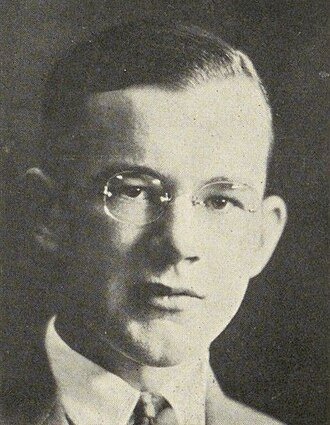
James Burnham
1905–1987 · American philosopher and political theorist
James Burnham (Chicago, 1905 – Kent, Connecticut, 1987) was an American philosopher and political theorist whose career moved from Marxism and anti-Stalinism to the conservatism of the Cold War. His work draws on the tradition of elite theory associated with Machiavelli, Pareto and Mosca, which is why it still turns up in debates about power.
He was educated at Princeton and studied at Oxford, and from 1929 taught philosophy at New York University. He was active in the American Trotskyist movement until 1940, when, alongside Max Shachtman, he argued that the Soviet Union was not a workers' state but a new form of class society. Soon afterwards he left the radical movement. In 1941 he published The Managerial Revolution, which argued that a new class of managers, technicians, bureaucrats and military men was displacing both capitalists and workers. During the Cold War he backed a hard line against the Soviet Union, wrote for National Review and worked for the OSS.
His theory of managerial elites influenced George Orwell, and in Suicide of the West (1964) he cast liberalism as a moral weakness. He received the Presidential Medal of Freedom in 1983. His influence reached neoconservatism and parts of the American right.
Key ideas
- The managerial revolution. A new class of managers, technicians, bureaucrats and military men, Burnham argued, was replacing the old capitalist class as the dominant power, as he believed had happened in Nazi Germany and the USSR.
- Circulation of elites. Burnham held that the new elite would keep some liberal features, such as political opposition and a free press, where these served its interests.
- A critique of liberalism. In Suicide of the West, liberalism appears as a syndrome shaped by guilt and internal contradictions.
- World power over balance. He favoured an aggressive strategy against the USSR and a US-led federation with hegemonic power, rather than a balance of power.
Curiosities
Teachers at Oxford
He studied at Balliol College, Oxford, where one of his professors was J. R. R. Tolkien.
A religious ending
According to the sources, he rejected Catholicism as a college student, but he is said to have returned to the faith of his youth on his deathbed.
An influence on Orwell
George Orwell drew on The Managerial Revolution for Nineteen Eighty-Four, although he never fully shared Burnham's attitude towards power.
Teachers and influences
Influenced by
- Niccolò Machiavelli 1469–1527
- Vilfredo Pareto 1848–1923
- Georges Sorel 1847–1922
Original Filopedia text based on Wikipedia (es) and Wikipedia (en) and Wikidata.