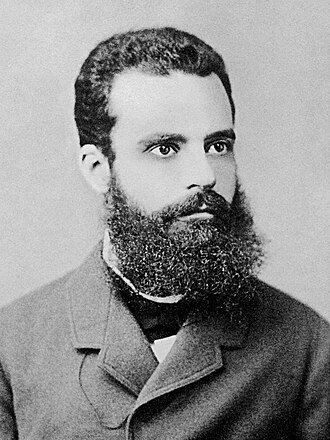
Vilfredo Pareto
1848–1923 · Italian economist, sociologist and engineer
Vilfredo Pareto (Paris, 1848 – Céligny, 1923) was an Italian polymath trained as an engineer who came to economics and sociology in his middle years. His name is attached to the Lausanne School, to the concept of Pareto efficiency and to the popular use of the word «elite» in social analysis. He matters because the paths he opened in microeconomics and sociology were followed for decades afterwards.
He was born in Paris into a Genoese family exiled for its patriotic politics; his father had left Italy as a supporter of Mazzini. Pareto spent his early years in France, but the family returned to Italy in 1858 and he was educated there, earning a doctorate in engineering in Turin in 1869. For about twenty years he worked as an engineer for railway and iron-mining companies. That work brought him into contact with protectionist tariffs, against which he became a committed free-trade campaigner.
In his forties his attention turned to abstract economic theory. An article by Maffeo Pantaleoni drew him in, and what began as a pastime soon became his main occupation. He wrote for the Giornale degli Economisti and applied mathematics to economics, building on Jevons, Walras and Cournot. In 1893 he succeeded Walras in the chair of political economy at Lausanne, a post he held until retiring in 1906. He then settled at Céligny, near Geneva, where he wrote his best-known books, the Manual of Political Economy and the Treatise on General Sociology.
In economics he developed the indifference curve, which shows combinations of goods that give a consumer the same satisfaction. From this came the idea of Pareto optimality: an allocation in which no one can be made better off without making someone else worse off. He also observed that income followed a regular statistical pattern, the Pareto distribution, and the 80/20 rule later popularised by Joseph Juran grew from his observations on wealth.
His social thought changed course over time. He began as a radical liberal and ended as a critic of socialism and parliamentary democracy. In the Treatise he argued that human action rests less on logic than on instinctive «residues», and that history unfolds through the rise and decline of elites, a cycle he described as a graveyard of aristocracies.
His influence runs through microeconomics, general equilibrium theory and the sociology of elites, and reached American sociology through figures such as Talcott Parsons. He is read today both as a technical economist and as a controversial political thinker.
Key ideas
- Pareto optimality: an allocation in which no one can be made better off without making someone else worse off.
- Indifference curves: representations of combinations of goods that give a consumer the same level of utility.
- Circulation of elites: history seen as a succession of ruling minorities that renew themselves or fall.
- Residues and derivations: the non-logical impulses behind human action and the rational justifications added to them afterwards.
- The 80/20 rule: the observation that a small minority holds most of the wealth.
Works in Filopedia
Curiosities
A change of name
He was born Wilfried Fritz Pareto; his parents chose the name out of enthusiasm for the 1848 revolutions in the German states, and after the family moved back to Italy he became Vilfredo Federico.
A thesis on equilibrium
His 1869 engineering doctorate dealt with the fundamental principles of equilibrium in solid bodies, an idea he later carried into economics and sociology.
Teachers and influences
Influenced by
- Niccolò Machiavelli 1469–1527
Influenced
- Antonio Gramsci 1891–1937
- Carl Schmitt 1888–1985
- Julius Evola 1898–1974
- James Burnham 1905–1987
Original Filopedia text based on Wikipedia (es) and Wikipedia (en) and Wikidata.