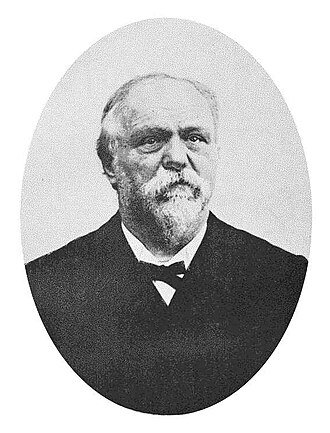
Georges Sorel
1847–1922 · French philosopher and theorist of revolutionary syndicalism
Georges Sorel (Cherbourg, 1847 - Boulogne-sur-Seine, 1922) was a French thinker who began as an engineer and became one of the most controversial voices in early twentieth-century socialism. The label Sorelianism gathers the many readers who drew on his work, among them socialists, anarchists, Marxists and fascists. He is best remembered for his notion of myth as a force that mobilises collective action, and for his defence of violence as an engine of historical change.
The son of a businessman, he studied at the École Polytechnique and in 1869 joined the corps of engineers responsible for public works. For more than two decades he was posted to Corsica, southern France and colonial Algeria, until he retired in 1892 and settled near Paris, in Boulogne-sur-Seine, with Marie David, a former factory worker with whom he never married. From the mid-1880s he published on subjects as varied as meteorology and religious history, showing the influence of Taine and Renan. His Reflections on Violence, published in 1908, remains his best-known book.
In 1893 he declared himself a Marxist and a socialist. His reading of Marx was mixed with Proudhon, Vico and Bergson, and in the debate over the crisis of Marxism he sided with Bernstein against Kautsky and Labriola. Sorel rejected economic and historical determinism: for him Marxism was not a science able to predict the future but an ideology that gave meaning to the action of a class. Around 1905 he helped give theoretical shape to revolutionary syndicalism, which saw the trade unions as the basis of a new society. The general strike, which had to be violent, was the means by which power would pass from the declining middle class to the proletariat.
His political stances were unstable. After 1909 he had an ambivalent contact with Maurras's Action Française, he denounced the war of 1914, and after the Russian Revolution he praised Lenin. His attitude towards Mussolini is disputed, since the only testimony suggesting sympathy comes from a posthumous work that is hard to verify. He died in 1922 and was buried at Tenay, in the vault of his adopted son.
His influence has been large and ambiguous. Mussolini cited him with interest, while Lenin barely mentioned him. Today he is read both as an unorthodox critic of Marxism and as a thinker of decline, and his work remains a key reference for understanding the links between myth, violence and collective action.
Key ideas
- Myth: the force of a shared belief to mobilise people matters more than the accuracy of its predictions.
- Proletarian violence: the general strike, to be effective, had to be violent, and he saw in it the means for the working class to assume its role.
- Revolutionary syndicalism: trade unions had to be more than resistance to capital, becoming the seed of new social relations.
- Critique of determinism: history follows no laws that allow the future to be foreseen, because it depends on the creative action of classes.
Curiosities
A praise for Lenin
Sorel called Lenin 'the greatest theoretician of socialism since Marx', a judgement that surprises in an author so critical of orthodox Marxism.
A family tomb
He was buried at Tenay, in the vault of his adopted son Jean-Baptiste David.
Teachers and influences
Influenced
- Antonio Gramsci 1891–1937
- Benedetto Croce 1866–1952
- Carl Schmitt 1888–1985
- Julius Evola 1898–1974
- James Burnham 1905–1987
Original Filopedia text based on Wikipedia (es) and Wikipedia (en) and Wikidata.