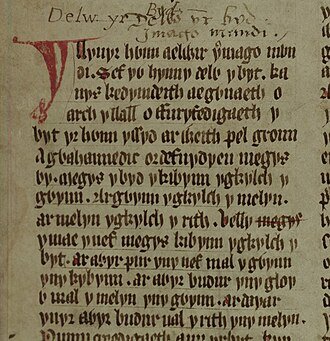
Honorius Augustodunensis
1080–1154 · 12th-century Christian theologian and cosmologist from Germany
Honorius Augustodunensis (c. 1080-c. 1153), known in English as Honorius of Autun, was a priest, theologian, philosopher and cosmologist working in the Christian intellectual world of the twelfth century. His by-name, Augustodunensis, was long taken to point to Autun in France, but that identification is now widely rejected, and scholars have proposed other places, such as Augsburg or Regensburg. What is reasonably certain is that he was a monk, that he spent time in England, and that he was for some years a student of Anselm of Canterbury.
Little is known about his life, yet his writings are numerous and most of them survive. Towards the end of his life he was at a Scots monastery in Regensburg, where he wrote and compiled a wide range of works. The Elucidarium, a survey of Christian belief in dialogue form, was translated into many vernacular languages. The Imago mundi, an encyclopedia of geography and cosmology with a chronicle of world history, was equally popular across the Middle Ages. He also wrote commentaries on the Song of Songs and the Psalms, and the De luminaribus ecclesiae, a list of Christian authors ending with his own works.
His thought blends Platonism with a realist view of universals, which set him against the nominalists of his day. In the doctrine of the Trinity he held that the created world comes from the mind of God, and in Christology he stressed a close interpenetration of Christ's two natures. In the investiture controversy, his Summa gloriae de Apostolico et Augusto, written around 1123, is one of the first texts to state clearly that temporal authority derives from the spiritual. His influence reached cosmology, liturgy and medieval political debate.
Key ideas
- Philosophical realism: universals have real existence, which is why he defended the essential unity of God against the nominalists.
- Emanation of the world: everything created exists in the mind of God and proceeds from him.
- Primacy of spiritual power: temporal authority derives from the Church, which instituted Christian kingship to protect the faithful.
- Ascent of the soul by stages: ignorance is the exile of the human being, and knowledge is reached step by step, from the liberal arts to the vision of God.
Works in Filopedia
Original Filopedia text based on Wikipedia (es) and Wikipedia (en) and Wikidata.