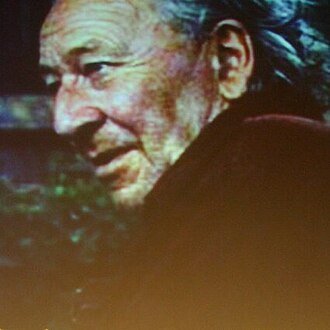
Gregory Bateson
1904–1980 · British-American anthropologist, cyberneticist and systems thinker
Gregory Bateson (Grantchester, 1904 - San Francisco, 1980) was a British thinker, later based in the United States, whose work ran across anthropology, biology, linguistics and cybernetics. He is best remembered for bringing systems theory and the study of communication into the fields of the mind, psychiatry and human relationships.
The son of the geneticist William Bateson, he trained in biology at Cambridge. His first fieldwork took place in New Guinea, where he studied the Iatmul people, and from that experience came his concept of schismogenesis, set out in Naven (1936). During the Second World War he worked for the OSS. He settled in the United States in 1939, became a naturalised citizen in 1956, and was married to the anthropologist Margaret Mead from 1936 to 1950.
During the 1940s he took part in the Macy conferences on cybernetics, where he argued for the place of the social and behavioural sciences in the debate. In Palo Alto, together with Donald Jackson, Jay Haley and John Weakland, he developed the double-bind theory to account for communication patterns linked to schizophrenia. In his final years he worked on what he called a meta-science of epistemology, an attempt to bring together the early forms of systems theory.
His ideas rest on one conviction: the mind does not live only in the brain but in patterns of relationship. For Bateson the whole takes priority over its parts, and communication holds up both social life and learning. His essayistic style, full of metaphor, made him hard to place within academia. His influence, however, reached family therapy and neurolinguistic programming, and his work remains a reference point in systems theory.
Key ideas
- Schismogenesis: a process by which the behaviour of two people differentiates through their interaction, either symmetrically between equals or complementarily between unequals.
- Double bind: a communicative situation in which contradictory messages are received and there is no way out, which Bateson linked to schizophrenia.
- Context: the meaning of a message depends on the frame in which it occurs, and so does its correct interpretation.
- Primacy of the whole: relationships between people explain behaviour better than isolated individuals, because the system takes precedence over its parts.
- Communication as social foundation: communicative processes sustain human relationships and are part of evolution.
Curiosities
A name drawn from genetics
He was named after Gregor Mendel, the Austrian monk who founded modern genetics, a nod to the field of his father.
Colleague of Julia Child in the OSS
During the war he shared offices with Julia Child, then Julia McWilliams, and Paul Cushing Child, and spent much of his time designing black propaganda radio broadcasts.
A lifelong atheist
He was an atheist all his life, as his family had been for several generations.
Teachers and influences
Influenced
- Donna Haraway b. 1944
Original Filopedia text based on Wikipedia (es) and Wikipedia (en) and Wikidata.