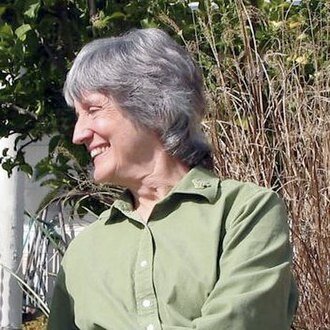
Donna Haraway
b. 1944 · American philosopher and scholar of science and technology studies
Donna Haraway (born in 1944) is an American scholar whose work sits at the intersection of feminist theory, science and technology studies, and contemporary ecofeminism. Trained in zoology and biology, she has become one of the most influential voices on the relations between humans, machines, animals, and other nonhuman processes.
Born in Denver, Colorado, she was taught by nuns in her early years, an influence she has noted in the way she thinks about the link between the figurative and the material. She studied zoology at Colorado College, spent time in Paris on a Fulbright scholarship, and completed a PhD in biology at Yale in 1972 with a dissertation on the role of metaphor in designing experiments, later published as a book. She taught at the University of Hawaiʻi and Johns Hopkins University before joining the University of California, Santa Cruz, in 1980, where she became the first tenured professor of feminist theory in the United States.
Her best-known work, the essay “A Cyborg Manifesto” (1985), uses the figure of the cyborg, a fusion of machine and organism, to argue for a feminist politics that embraces contradictions rather than resolving them. Haraway contends that women are no longer outside the technological and economic hierarchies of their time but deeply embedded in them, and that politics must start from that position. In Primate Visions she examined how metaphors and narratives in primatology tend to masculinize reproductive competition and leave other interpretations aside, while feminist primatologists attended to communication, care, and everyday survival. Later, in Staying with the Trouble, she developed the idea of speculative fabulation and the proposal of “making kin” rather than “making babies” as a response to the ecological crisis of the Anthropocene.
Her influence reaches feminist theory, science studies, the philosophy of biology, and environmental thought, and her books are now key references for anyone who wants to rethink the boundary between the human and the nonhuman.
Key ideas
- Cyborg: the figure of a fusion between machine and organism, used to think feminist identities and politics without closed categories.
- Critique of anthropocentrism: the idea that nonhuman processes have their own self-organizing powers, which culture and ethics must take into account.
- Metaphors in science: scientific accounts of nature, such as those in primatology, are shaped by metaphors of gender, race, and class that deserve scrutiny.
- Making kin: the proposal to attend to the ties between beings rather than focusing on increasing births, as a response to the ecological crisis.
- Speculative fabulation: a mode of attention and world-building that joins academic writing and everyday life.
Works in Filopedia
- A Cyborg Manifesto 1984
Curiosities
A father in sports journalism
Her father, Frank O. Haraway, was a sportswriter for The Denver Post.
A year in Paris
After college she moved to Paris, where she studied evolutionary philosophy and theology at the Fondation Teilhard de Chardin on a Fulbright scholarship.
Teachers and influences
Influenced by
- Gregory Bateson 1904–1980
Influenced
- Isabelle Stengers b. 1949
Original Filopedia text based on Wikipedia (es) and Wikipedia (en) and Wikidata.