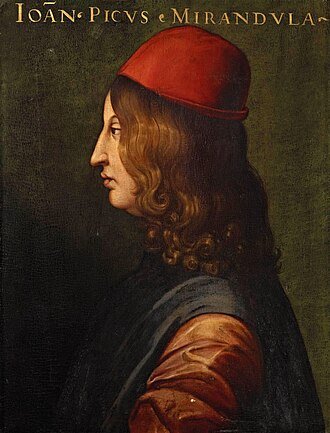
Giovanni Pico della Mirandola
1463–1494 · Italian Renaissance humanist and philosopher, founder of Christian Kabbalah
Giovanni Pico della Mirandola (1463-1494) was an Italian Renaissance humanist and nobleman whose wide learning earned him the name of polymath. He is remembered above all for 1486, when, at just twenty-three, he proposed to defend nine hundred theses on religion, philosophy, natural philosophy and magic against any challenger in Rome. The introduction to those theses, the Oration on the Dignity of Man, is often called a manifesto of the Renaissance and a key text of humanism.
He was born at Mirandola, near Modena, the youngest son of a local lord. His mother intended him for the Church, and at ten he was named papal protonotary, probably as an honorary title. He studied canon law at Bologna, but after his mother's death he abandoned it for philosophy at Ferrara and then Padua, where he learned Hebrew and Arabic from Elia del Medigo, a Jewish Averroist. In 1485 he went to Paris, the great centre of scholastic learning, and there he began to shape his theses.
Back in Italy he settled in Florence, where he met Marsilio Ficino and Lorenzo de' Medici, who became his protector. A love affair in Arezzo landed him in prison and then in a long recovery in Perugia, where he encountered Hebrew Kabbalah and the Hermetic writings. His project was to show that Christianity was the point where the great philosophical and religious traditions met. Pico sought a harmony between Plato and Aristotle, whom he saw as voicing one truth in different words, and he believed Hermetic and Kabbalistic texts pointed to the same God of the Old Testament.
The Church refused to accept the plan. Thirteen theses were judged suspect of heresy, and the planned Roman debate was halted. Pico wrote an Apology defending his positions, which was read as arrogance, and he was excommunicated. After fleeing to France he spent time in prison until the future king Charles VIII interceded for him. Around 1490 he gave up his wealth and lived with intense religious devotion, and in 1493 Pope Alexander VI absolved him. He never retracted his theses. He died in Florence in 1494, aged thirty-one. A rumour blamed poisoning, and modern forensic work on his remains pointed to arsenic, though who was responsible remains unclear.
His legacy is twofold. He founded Christian Kabbalah, which became a central strand of early modern Western esotericism. And his Oration, with its defence of freedom of thought and cultural plurality, places him among the humanist thinkers of his age. His critique of astrology, published posthumously in the Disputations against Divinatory Astrology, also had lasting influence.
Key ideas
- Dignity of man: humans have no fixed place in the cosmic hierarchy and can shape their own lives, rising or falling by their choices.
- Concord of doctrines: the great philosophical and religious traditions, from Plato to Aristotle, the Kabbalah and Hermetism, express a shared truth in different words.
- Christian Kabbalah: Hebrew mystical texts, read in the light of Christ, were taken to confirm Christianity.
- Critique of astrology: the stars do not determine human freedom, so divinatory astrology conflicts with moral choice.
Works in Filopedia
Curiosities
Nine hundred theses
The 1486 theses were, according to the sources, the first printed book to be universally banned by the Church.
Prince of Concord
His friends called him "Princeps Concordiae", a pun on Concordia, one of his family's holdings.
Teachers and influences
Teachers
- Elia del Medigo 1458–1493
Influenced
- Gottfried Wilhelm Leibniz 1646–1716
- Erasmus 1466–1536
Original Filopedia text based on Wikipedia (es) and Wikipedia (en) and Wikidata.