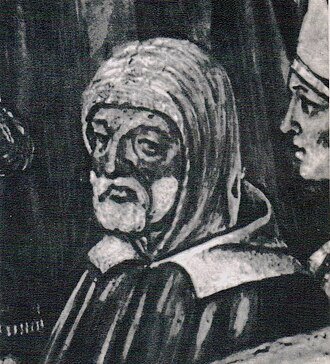
Elia del Medigo
1458–1493 · Averroist philosopher from Crete of Jewish origin
Elia del Medigo (c. 1458 – c. 1493), also known as Elijah Delmedigo or Elias ben Moise del Medigo, was a Jewish philosopher born in Candia, on the island of Crete, then under the rule of the Venetian Republic. He belonged to the Averroist tradition, which read Aristotle through the commentaries of Averroes, and he matters because he linked medieval Jewish thought with the Christian humanists of the early Italian Renaissance.
His family had moved from Germany to Crete. He received a traditional religious education but also studied philosophy, and he read Italian, Greek, Latin and Hebrew. He probably trained in medicine, which may explain his trip to Padua, the leading centre of Aristotelian philosophy in Italy. By about 1480 he was in Venice, where he wrote a treatise on whether the world is an effect, and he earned a living teaching the sons of wealthy families. He later taught radical Aristotelianism in Perugia, where he met Pico della Mirandola, for whom he translated from Hebrew and wrote two short pamphlets. Another pupil, Domenico Grimani, later a cardinal, became a steady patron.
He gradually distanced himself from Pico, whose project mixed magic, Hermeticism and Kabbalah with Platonism. After Pico's fall and his own financial troubles, he returned to Crete, where he spent his final years. There he wrote the Sefer Beḥinat ha-Dat (The Examination of Religion), published in 1629, in which he challenged the antiquity of the Kabbalah and defended reason against the notion that a human being can become a god.
His influence reached the Italian Platonists and later Jewish thinkers, among them his descendant Joseph Solomon Delmedigo.
Key ideas
- Unity of the intellect: human reason participates in a single, shared intellect, an idea inherited from Averroes.
- Eternity of the world: the cosmos has no beginning in time, a thesis he defended against the religious reading of creation.
- Autonomy of reason: philosophical knowledge should be guided by reason rather than simply subordinated to revelation.
- Critique of the Kabbalah: he denied that the Kabbalah was ancient and that Shimon bar Yochai wrote the Zohar.
- Human limits: a person cannot aspire to become a god; rationality and sobriety are the proper path.
Curiosities
Possible literary model
He is considered likely to have inspired the character Judah del Medigo in Jacqueline Park's novel The Secret Book of Grazia dei Rossi.
Teachers and influences
Pupils
- Giovanni Pico della Mirandola 1463–1494
Original Filopedia text based on Wikipedia (en) and Wikidata.