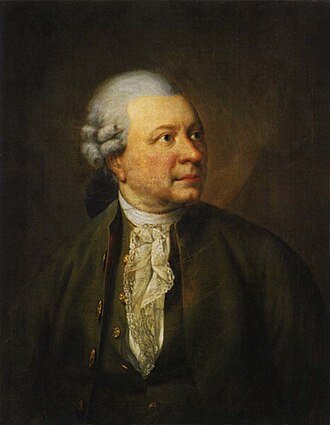
Friedrich Gottlieb Klopstock
1724–1803 · German poet
Friedrich Gottlieb Klopstock (Quedlinburg, 1724 - Hamburg, 1803) was a German poet of the eighteenth century, often credited with helping to shape the poetic language of modern German. His epic The Messiah and his championing of the hexameter place him at the start of a literature that began to look beyond French models.
The eldest son of a lawyer of quiet and deeply religious temperament, he spent a happy childhood in Quedlinburg and on a country estate by the Saale. He grew up strong and became an excellent horseman. In 1739 he entered the famous classical school at Schulpforta, where he excelled at Greek and Latin verse. There he began writing odes in German and sketched a religious epic inspired by Milton's Paradise Lost, which replaced an earlier plan about Henry the Fowler.
After leaving school he studied theology at Jena, but moved to Leipzig in 1746 and joined a circle of young writers linked to the Bremer Beiträge. In 1748 the first three cantos of The Messiah appeared there anonymously, in hexameters, and the author's name soon became known. His private life also left its mark. After an unrequited love in Langensalza, he married Margareta Moller, who died in 1758, and his grief surfaces in the fifteenth canto of the poem.
He spent time in Zurich with Bodmer, with whom he later fell out, and then settled in Copenhagen at the invitation of the Danish king, with an annuity that allowed him to finish his epic. After his patron Count Bernstorff was dismissed in 1770, he moved to Hamburg, where the last five cantos appeared in 1773. A year at the court of Karlsruhe followed, and in 1776 he returned to Hamburg for good. He followed the American War of Independence and the French Revolution with interest, but returned the honorary French citizenship the republic had granted him, appalled by the violence committed in liberty's name.
His legacy is uneven. His odes, personal and religious in tone, are arguably his finest work, while The Messiah, for all its memorable passages, struggles to turn redemption into epic material, and its later cantos fall short of the early ones. Still, his insistence on the poet's artistic independence and on the hexameter influenced Goethe and Hölderlin, and Gustav Mahler set his poem The Resurrection to music in the finale of his Second Symphony.
Key works
- The Messiah (1748-1773), a religious epic on which he worked for much of his life.
- The Death of Adam (1757), a drama on a biblical theme.
- Hermann's Battle (1769), a drama about the deeds of the German hero Arminius.
- The Republic of Scholars (1774), a scheme for renewing German letters.
Works in Filopedia
- The Messiah 1748
Curiosities
Mahler and The Resurrection
According to a common account, his hymn Die Auferstehung, sung at the funeral of Hans von Bülow in 1894, inspired Gustav Mahler's final movement of his Second Symphony, to which the composer added verses of his own.
A returned citizenship
In 1792 the French Republic granted him an honorary citizenship diploma, which Klopstock returned shortly afterwards, horrified by the excesses of the Revolution.
A remembered wife
His first wife, Margareta Moller, died in childbirth in 1758. Decades later, Klopstock was buried beside her in the churchyard at Ottensen.
Teachers and influences
Influenced by
- Homer 900 BC–800 BC
- Virgil 69 BC–18 BC
- Horace 64 BC–7 BC
- John Milton 1608–1674
- Pindar 516 BC–436 BC
Influenced
- Johann Heinrich Voss 1751–1826
Original Filopedia text based on Wikipedia (es) and Wikipedia (en) and Wikidata.