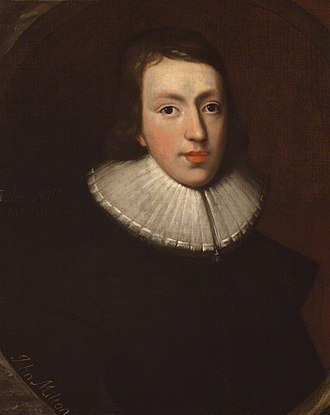
John Milton
1608–1674 · English poet and essayist
John Milton (London, 1608 – London, 1674) was an English poet, essayist and public servant who lived through the move from Stuart monarchy to Cromwell's republic. He wrote mostly in English, although he was fluent in Latin, Greek and Hebrew and read several modern languages. He is now counted among the central figures of English poetry, and his epic Paradise Lost is the work for which he is best known.
He was born in London into a comfortable household. His father, also called John, was a scrivener and a composer of church music, and the son inherited a lasting love of music. He was educated at St Paul's School and then at Christ's College, Cambridge, where he took his degree in 1632. His fellow students mocked his delicate looks and nicknamed him the "Lady of Christ's", and his dealings with some of his tutors were strained. A story says that he was briefly sent away after a quarrel with one of them, though historians now treat that tale with caution.
After Cambridge he spent several years at his family's home in Hammersmith and later at Horton in Berkshire, reading widely in theology, philosophy, history, politics and science. In 1638 he travelled through France and Italy, and he probably met Galileo in Florence while the astronomer was under Inquisition supervision. The civil war that was gathering in England changed his course. He set aside private poetry for a time and began writing pamphlets against the power of the bishops and in favour of reform of the Church of England.
In 1642 he married Mary Powell, then seventeen, who left him soon afterwards and returned to her parents. Out of that failed marriage came his tracts on divorce, published in 1643 and 1644, which argued that marriage could be dissolved when partners were incompatible. They caused an uproar among the clergy and in Parliament. In 1644 he published Areopagitica, a plea against licensing books before publication that remains one of the most quoted defences of a free press. During the Commonwealth he worked for the republican government, and later under Cromwell, handling foreign-language correspondence, a post that gave him real public standing.
The Restoration of 1660 removed him from public life and left him far less visible than he had been. Almost blind, he returned to poetry and completed Paradise Lost, published in 1667 in twelve books and written in blank verse, which means unrhymed lines. The poem tells of the fall of man, of the temptation of Adam and Eve by the fallen angel Satan, and of their expulsion from Eden. Milton widened the English vocabulary with words drawn from Latin and Greek, and his dense, long-breathed syntax became a model for later writers. He died in London in 1674, poor but famous across Europe.
His legacy is twofold. He is credited with spreading blank verse in English poetry, and in the Romantic period his allusions were as common as those to classical authors. William Blake, William Wordsworth and Thomas Hardy admired him openly. His reputation has also been contested: his republican politics drew criticism in later centuries, and figures such as T. S. Eliot questioned parts of his work. Even so, he remains an essential name in English literature and one of the most influential defenders of freedom of expression.
Key works
- Paradise Lost (1667): an epic poem in twelve books, in blank verse, on the fall of man and the expulsion from Eden.
- Areopagitica (1644): a speech against pre-publication censorship and in favour of a free press.
- Lycidas (1638): a pastoral elegy written in memory of Edward King, a Cambridge friend who drowned in 1637.
- Comus (1634): a masque on the virtues of temperance and chastity, written for the Egerton family's celebrations.
Books to read
- Paradise Lost EnglishEPUB 327 KBRead online
- El paraíso perdido SpanishEPUB 599 KBRead online
- Areopagitica A Speech for the Liberty of Unlicensed Printing to the Parliament of England EnglishEPUB 111 KBRead online
- The Poetical Works of John Milton EnglishEPUB 471 KBRead online
- Paradise Regained EnglishEPUB 113 KBRead online
- Milton's Comus EnglishEPUB 223 KBRead online
- Milton: Minor Poems EnglishEPUB 198 KBRead online
- An Introduction to the Prose and Poetical Works of John Milton Comprising All the Autobiographic Passages in His Works, the More Explicit Presentations of His Ideas of True Liberty. EnglishEPUB 355 KBRead online
Curiosities
The Cambridge nickname
According to John Aubrey's account, his fellow students at Cambridge called him the "Lady of Christ's" because of his fair complexion and delicate looks. It was a mocking nickname that he resented.
Hebrew for Dutch
At Cambridge he befriended the theologian Roger Williams, teaching him Hebrew in exchange for lessons in Dutch. It was an unusual swap of skills between two students.
The Trinity Manuscript
Drafts of his early poems are kept at Trinity College, Cambridge, which gives them the name Trinity Manuscript. Charles Mason found the loose leaves in the college library around 1735.
Teachers and influences
Influenced
- William Blake 1757–1827
- T. S. Eliot 1888–1965
- John Keats 1795–1821
- Percy Bysshe Shelley 1792–1822
- George Sand 1804–1876
- C. S. Lewis 1898–1963
- Philip Pullman b. 1946
- Friedrich Gottlieb Klopstock 1724–1803
Original Filopedia text based on Wikipedia (es) and Wikipedia (en) and Wikidata.