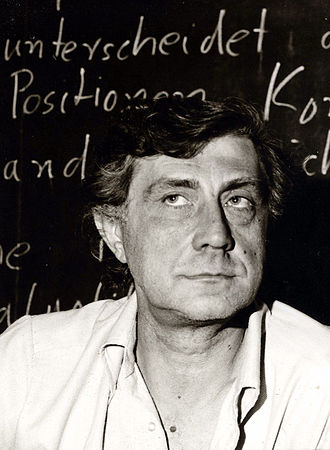
Franco Basaglia
1924–1980 · Italian psychiatrist who led the reform of mental hospitals
Franco Basaglia (Venice, 1924-1980) was an Italian psychiatrist whose work transformed mental health care in his country. Trained in a tradition shaped by phenomenology and existentialism, he is regarded as the leading figure in the movement to dismantle psychiatric institutions in Italy. He never used the label "antipsychiatry" himself, although he is often associated with it.
After studying medicine in Padua, where he had joined the anti-fascist resistance and spent time in prison, he worked in a university clinic. In 1961 he took charge of the mental hospital in Gorizia, where he saw that many symptoms seemed to fade once patients left the institution. He concluded that much of their suffering came from confinement itself. He later ran the hospital in Trieste, introducing workshops, patient cooperatives and an open-door system, and in 1973 he founded the Democratic Psychiatry movement. His aim was to close the asylums and replace them with community-based support.
This campaign led to Law 180 in 1978, which banned involuntary commitment and set Italy on the path to closing its mental hospitals. Basaglia died in Venice in 1980, at the age of 56. His influence reaches well beyond Italy, and the law remains a subject of debate.
Key ideas
- Critique of the total institution: the asylum subjects patients and staff alike to the same logic of confinement and decline.
- Restoring the patient's voice: people in psychiatric care should regain a say in decisions about their own lives rather than depend solely on the doctor's will.
- The social roots of suffering: Basaglia held that much of what was called madness stemmed from economic marginalisation and from the conditions of confinement.
- Deinstitutionalisation: reforming asylums is not enough; they must be closed and replaced by community and outpatient services.
Curiosities
The horse Marco Cavallo
Patients and collaborators at the San Giovanni hospital built a giant papier-mâché horse filled with their wishes. It paraded through Trieste after breaking through part of the hospital walls.
A questionnaire left unanswered
Basaglia declined to answer a questionnaire from the Swiss psychiatrist Christian Müller about an ideal psychiatric service. Instead he wrote a response, later published as La utopía de la realidad.
Teachers and influences
Influenced by
- Jean-Paul Sartre 1905–1980
Original Filopedia text based on Wikipedia (es) and Wikipedia (en) and Wikidata.