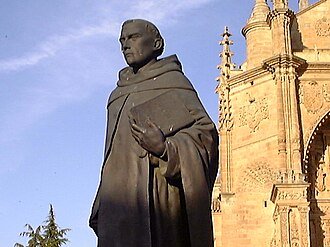
Francisco de Vitoria
1480–1546 · Spanish Dominican theologian and founder of the School of Salamanca
Francisco de Vitoria (Burgos, probably 1483 - Salamanca, 12 August 1546) was a Dominican friar, theologian and jurist who taught at the University of Salamanca. He is considered the founder of the so-called School of Salamanca and one of the fathers of modern international law. His thought, rooted in the Aristotelian-Thomist tradition, centred on the dignity of the human person and the moral limits of power, ideas that are still debated today.
He joined the Order of Preachers in 1505 at the convent of San Pablo in Burgos. After training in Paris, where he earned his doctorate in theology in 1522, he returned to Spain and in 1526 won the chair of theology at Salamanca, which he held until his death. There he made Thomas Aquinas' Summa Theologiae the basic textbook, helping spread Thomism to other universities. His students included Domingo de Soto and Melchor Cano.
His best-known contributions grew out of the debate over the conquest of the Americas. In his lectures De Indis he argued that the native peoples were true owners of their lands and goods, and could not be stripped of them for not being Christian. He rejected religious difference as a justification for war and, in De iure belli, limited just war to a proportionate response to an injury. Against the view that the state stood outside moral judgement, he held that political action has ethical limits and that peoples form a community governed by natural law.
He also wrote on economic matters. He regarded trade not as sinful in itself but as a service to the common good, and he opened discussion of a just price linked to scarcity and demand. His influence reaches the Laws of the Indies of 1542, the work of Hugo Grotius, and the history of the law of nations, often seen as an early antecedent of modern human rights.
Key ideas
- Human dignity: all people, including non-Christians, hold their own rights over their goods and their government.
- Just war: war can be justified only as a proportionate response to an injury, not by religious difference or territorial ambition.
- Community of peoples: relations between nations should be governed by natural law and not by force alone.
- Freedom of trade: the exchange of people, goods and ideas belongs to the natural order and serves the common good.
- Just price: the value of a good depends on its scarcity and on supply and demand, not only on its cost of production.
Curiosities
A mural in Geneva
The Council Chamber of the Palace of Nations in Geneva is named after him. One of its murals, painted by José María Sert and unveiled in 1936, shows him teaching at the University of Salamanca.
A council he never reached
In 1545 Charles V named him imperial theologian for the Council of Trent, but illness kept him from travelling.
Teachers and influences
Pupils
- Domingo de Soto 1494–1560
Original Filopedia text based on Wikipedia (es) and Wikipedia (en) and Wikidata.