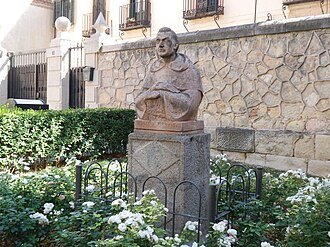
Domingo de Soto
1494–1560 · Spanish Dominican friar and theologian of the School of Salamanca
Domingo de Soto (Segovia, 1494 – Salamanca, 1560) was a Spanish Dominican friar, theologian and university professor, and one of the central figures of the School of Salamanca, the Thomist movement that reshaped theology and law in the sixteenth century. His significance lies both in his teaching and in his contributions to law, economics and physics.
He studied at Alcalá and Paris and taught philosophy at Alcalá before joining the Order of Preachers. From 1532 he held the theology chair at Salamanca, later succeeding Melchor Cano in it. He attended the Council of Trent as an imperial theologian and afterwards served as confessor to Charles V, who offered him the bishopric of Segovia, which he declined. In 1550-1551 he sat on the Valladolid junta, where he backed the Dominican position against the enslavement of Native Americans, opposing the arguments of Sepúlveda.
His best-known work, De iustitia et iure, deals with justice, law and contract and is regarded as a foundational text of international law. He also studied usury and the just price. He is traditionally credited with arguing, in the context of the physics of motion, that falling bodies accelerate uniformly, an idea Galileo acknowledged as a precedent. His legacy reaches modern law and the defence of indigenous peoples' rights.
Key ideas
- Law and justice: law should be judged by the ordinance of reason, and the law of nations forms part of the positive law of each community.
- Falling bodies: a body in free fall gains speed uniformly, an insight that anticipated Galileo's later work.
- Usury and the just price: lending at interest must be judged by moral criteria, and profit as the sole motive is considered immoral.
- Poverty and charity: rich and poor depend on one another, and the legitimate poor have a right to relief against restrictive policies.
Curiosities
A school named after him
In Segovia, his hometown, a primary school bears his name in honour of the city's distinguished figure.
A street in Salamanca
In Salamanca, where he spent most of his career, a street is named after him.
Teachers and influences
Pupils
- Francisco de Toledo 1532–1596
Original Filopedia text based on Wikipedia (es) and Wikipedia (en) and Wikidata.