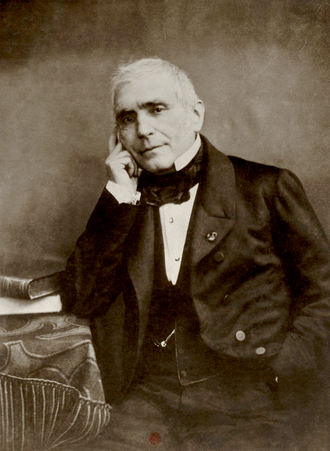
Eugène Scribe
1791–1861 · French playwright and librettist
Augustin Eugène Scribe (Paris, 1791-1861) was a French playwright and librettist who dominated the Parisian stage during the Restoration and the July Monarchy. He is associated with the "well-made play", a model of carefully constructed plot that held a place on popular stages for more than a century. His importance lies both in the sheer volume of his output and in the influence he had on later playwrights in France and beyond.
The son of a silk merchant, he trained for a legal career but was soon drawn to the theatre. His early pieces, written with friends such as Delavigne, attracted little notice. His breakthrough came in 1815 with the comedy Une nuit de la garde nationale, written with Delestre-Poirson, and from then on his career grew steadily. He usually worked in collaboration: he sketched the outline of a story and other writers helped shape the text. In this way he produced close to five hundred pieces, including comedies, vaudevilles, dramas and librettos.
From 1822 he was the regular librettist of the composer Daniel Auber, and he also worked with Rossini, Meyerbeer, Boieldieu and Donizetti. His librettos helped establish French grand opera. He wrote to entertain rather than to instruct, and his tightly built plots, focused on dramatic effect rather than psychological depth, drew criticism from intellectuals of his day. Even so, his method became a standard reference for the craft.
His novels were less successful than his plays. He kept a demanding routine, beginning to write early in the morning and working until noon, then spending the rest of the day on rehearsals, performances and friends.
Today he is remembered mainly for his operas, while much of his spoken drama has left the repertory. The Glass of Water is the only one of his comedies that modern audiences tend to recognise. His legacy lives on in the well-made plot that many playwrights adopted after him.
Key works
- A Night of the National Guard (1815), a comedy written with Delestre-Poirson that gave him his first major success.
- The White Lady (1825), a libretto for Boieldieu's opera based on stories by Walter Scott, and one of the first to bring the supernatural into an operatic plot.
- The Mute Girl of Portici (1828), a libretto for Auber, regarded as the first French grand opera.
- Bertrand et Raton, or The Art of Conspiracy (1830), a historical and political comedy that began a series of similar works.
- The Glass of Water (1840), a five-act comedy and the play of his that has best survived the passing of time.
Books to read
- Carlos Broschi SpanishGutenberg
Curiosities
A ballet with a playwright's plot
In 1827 he wrote the scenario for *La Somnambule*, a ballet for the Paris Opéra, which was unusual because until then the storyline of a ballet had been left to the house choreographer. Felice Romani later used the same scenario as the basis for Bellini's opera of the same name.
Recycled music
For *Le Comte Ory* (1828), Rossini reused music from *Il viaggio a Reims*, an occasional piece he had composed three years earlier, so many of the lines had to be fitted to tunes that already existed.
A pseudonym in his honour
The Spanish playwright and novelist Luis Martínez Eguílaz sometimes signed his work with the pseudonym El licenciado Escribe, a nod to the French dramatist, which shows how well known he was in Spain.
Teachers and influences
Influenced
- Ion Luca Caragiale 1852–1912
Original Filopedia text based on Wikipedia (es) and Wikipedia (en) and Wikidata.