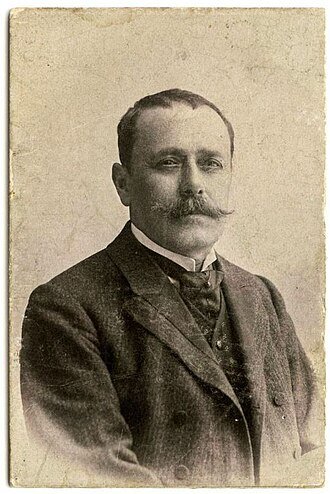
Ion Luca Caragiale
1852–1912 · Romanian playwright, journalist and short story writer
Ion Luca Caragiale (1852-1912) was a Romanian playwright, journalist and short story writer, generally regarded as the greatest dramatist in the Romanian language. Born in the Wallachian countryside and schooled in Ploiești, he wrote in a language that many educated Romanians still measured against French models. His plays are few in number, but they represent the high point of Romanian theatre in the nineteenth century.
His family was of Greek descent, with roots linked to Constantinople, an origin he himself tended to play down in later life. His father worked as a lawyer and judge, and his uncles Costache and Iorgu Caragiale were prominent figures in the theatre, which shaped his early ambitions. After his father died in 1870, he gave up the idea of becoming an actor and took on the role of head of the household. He worked as a prompter and copyist at the National Theatre in Bucharest and published verse and satirical prose, moving gradually into journalism, where he wrote for a succession of papers and magazines with very different political leanings.
His writing spans roughly four decades and mixes neoclassical structure, realism and naturalism with an original blend of foreign and local influences. His comedies satirise the politics and society of late nineteenth-century Romania, particularly the liberal parties and the world of local power. Some later stories move towards fantasy or historical fiction. As a journalist he was combative and often hard to place politically, clashing with leading figures of his day and drifting away from Junimea, the literary circle that had first backed him, after his quarrel with Titu Maiorescu in the early 1890s.
He spent his final years in Berlin, from where he continued to comment harshly on Romanian politics, and he died there in 1912. His legacy rests on his plays, which remain the reference point for Romanian theatre, and on his sharp journalistic voice. He was later elected posthumously to the Romanian Academy.
Key works
- A Stormy Night (O noapte furtunoasă, 1879): a political comedy about shifting fortunes in local power, often considered his most important play.
- Don Leonida Faces the Reaction (Conu Leonida față cu reacțiunea, 1880): a one-act comedy about a man with conservative views confronting the changes of his time.
- A Lost Letter (O scrisoare pierdută, 1884): a comedy of municipal politics and electoral intrigue, perhaps his most performed work.
- The Calumny (Năpasta, 1890): a darker drama of rumour and revenge in a rural community.
Curiosities
A name with an awkward syllable
His full name repeats the syllable ca twice, a combination Romanian usually avoids because of its scatological associations. The Romanian Academy nonetheless accepted it as one of the few such cacophonies it allows.
A disputed origin
According to tradition, his paternal grandfather was a cook at the court, and the writer himself referred to roots on the island of Hydra. Later research has proposed other origins, so the question remains debated.
Teachers and influences
Influenced by
- Eugène Scribe 1791–1861
- Victorien Sardou 1831–1908
- Eugène Labiche 1815–1888
- Georges Courteline 1858–1929
Influenced
- Eugène Ionesco 1909–1994
Original Filopedia text based on Wikipedia (es) and Wikipedia (en) and Wikidata.