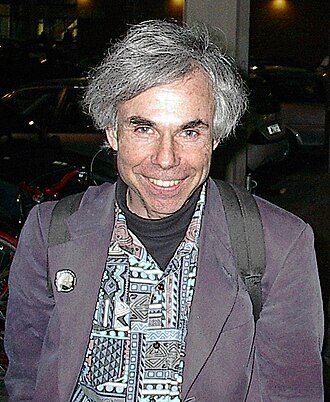
Douglas Hofstadter
b. 1945 · American cognitive scientist, philosopher and academic
Douglas Richard Hofstadter (born in New York in 1945) is an American cognitive scientist, philosopher and academic whose work sits at the meeting point of logic, psychology, artificial intelligence and the arts. He is best known for his 1979 book Gödel, Escher, Bach: An Eternal Golden Braid, which won the Pulitzer Prize for general nonfiction and gave self-reference a reach far beyond mathematics.
The son of physicist Robert Hofstadter, who won the Nobel Prize in 1961, he grew up on the Stanford University campus, where his father taught. He graduated in mathematics from Stanford in 1965 but left graduate work in that field, and he took his PhD in physics at the University of Oregon in 1975. After a period at MIT's Artificial Intelligence Laboratory, he joined Indiana University in 1977, where he directs a research centre on concepts and cognition and has championed an approach to the mind built on analogy and high-level perception.
In Gödel, Escher, Bach he draws parallels between mathematical theorems, the work of Escher, Bach's fugues and biological processes, in order to show how a system can contemplate itself. From this comes his notion of the strange loop, a structure that crosses levels and returns to its starting point, whose prototype is the self-reference at the heart of Gödel's theorems. In 2007 he published I Am a Strange Loop, arguing that the self is a necessary illusion, a pattern arising from brain activity that, in his view, can be spread across several brains.
Hofstadter is also a translator. He rendered Pushkin's verse novel Eugene Onegin into English verse and translated works by Sagan and Veltroni. He has created ambigrams, letter designs that read differently depending on orientation, and in Le Ton beau de Marot he humorously describes himself as "pilingual" and "oligoglot". His influence extends to popular accounts of cognitive science and to public debate about artificial intelligence, where he has voiced doubts about predictions of an imminent technological singularity.
Key ideas
- Strange loop: a structure that crosses the levels of a system and, after traversing them, returns to its starting point, as self-reference does in Gödel's work.
- The self as a pattern: the sense of having an "I" would arise from an abstract pattern created by brain activity, not from a separate entity.
- Analogy as the engine of thought: for Hofstadter, the ability to perceive similarities between situations is central to human cognition.
- Creativity and form: art and mathematics share processes of self-reference and constraint that can be studied rigorously.
Works in Filopedia
Curiosities
Pulitzer Prize
Gödel, Escher, Bach won the Pulitzer Prize for general nonfiction, as well as a National Book Award in the science category.
Hofstadter's law
In the book he states a humorous law: everything takes longer than you expect, even when you account for Hofstadter's law.
Teachers and influences
Influenced
- David Chalmers b. 1966
Original Filopedia text based on Wikipedia (es) and Wikipedia (en) and Wikidata.