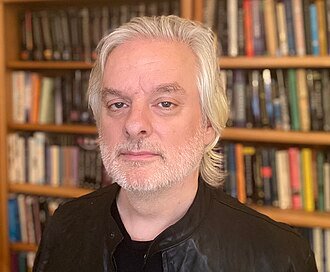
David Chalmers
b. 1966 · Australian philosopher of mind and language
David Chalmers (born in Sydney, 1966) is an Australian philosopher working in the analytic tradition, best known for his work on the philosophy of mind and the philosophy of language. He is famous for formulating the hard problem of consciousness and for popularising the philosophical zombie thought experiment. His work sits at the center of contemporary debate about how subjective experience fits into a physical world.
He grew up in Adelaide, where he studied mathematics. At thirteen, reading Douglas Hofstadter's Gödel, Escher, Bach sparked his interest in philosophy. After a period at Oxford, he earned his PhD in 1993 from Indiana University in philosophy and cognitive science, working under Hofstadter. His dissertation became the book The Conscious Mind (1996). He then taught in California and Arizona, returned to Canberra, and from 2009 has been affiliated with New York University.
His most influential idea separates the 'easy' problems of consciousness, such as explaining how we discriminate stimuli or make verbal reports, from the hard problem: why there is subjective experience at all alongside those processes. Chalmers argues that physical explanations leave a gap, and defends a naturalistic dualism in which minds depend on physical systems without being reducible to them. To make the point he uses the philosophical zombie, a physical duplicate with no experience, whose conceivability, he argues, shows that experience is not exhausted by the physical.
His influence reaches well beyond the philosophy of mind. He is one of the driving figures in the scientific study of consciousness and co-founded PhilPapers, a database of philosophy articles. His arguments remain a reference point for supporters and critics alike.
Key ideas
- The hard problem of consciousness: the question of why physical brain processes come with subjective experience is not settled by functional explanation.
- Naturalistic dualism: minds depend on physical systems such as the brain, yet cannot be reduced to them.
- The philosophical zombie: a physical duplicate with no conscious experience whose conceivability, for Chalmers, shows that the physical does not explain everything.
- Fading qualia: if each neuron were replaced by a functional equivalent, consciousness could not fade without the subject noticing, which supports the idea that functional organization is enough for experience.
Curiosities
Childhood synesthesia
As a child he experienced synesthesia, a blending of sensory perceptions that are usually kept apart.
Early programmer and maths medallist
At the age of ten he began coding and playing computer games on a PDP-10 at a medical center. He also won a bronze medal at the International Mathematical Olympiad.
A bet about consciousness
In 1998 he bet neuroscientist Christof Koch a case of wine that the neural basis of consciousness would not be resolved by 2023. He won the bet in 2023.
Teachers and influences
Influenced by
- Bertrand Russell 1872–1970
- Douglas Hofstadter b. 1945
Original Filopedia text based on Wikipedia (es) and Wikipedia (en) and Wikidata.