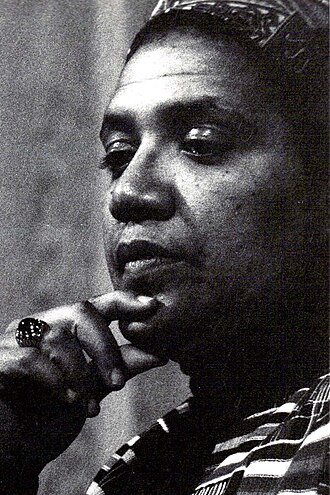
Audre Lorde
1934–1992 · Black American poet, essayist, feminist and civil rights activist
Audre Lorde (New York, 1934 - Saint Croix, 1992) was a Black American poet, essayist and civil rights activist. A lesbian feminist, she wrote from within the Black feminist tradition of the late twentieth century, and her way of thinking about how race, gender, sexuality and class overlap remains a key reference for anyone studying intersectionality.
The daughter of Afro-Caribbean immigrants from Grenada, she grew up in Harlem. She learned to read at the age of four and wrote her first poems while still at primary school. She studied at Hunter College and, in 1954, spent a formative year at the National Autonomous University of Mexico, a period she later described as one of affirmation and renewal. In 1961 she earned a master's degree in library science from Columbia University and worked as a librarian before turning to teaching. In 1978 she was diagnosed with breast cancer, an experience that shaped much of her later writing.
Her poetry, including The First Cities (1968) and Cables to Rage, combines technical control with raw anger at social injustice. Zami: A New Spelling of My Name blends memoir and myth, while Sister Outsider gathers essays on racism, sexism and heterosexist oppression. Lorde rejected the idea that some oppressions matter more than others. In her view, racism, classism, sexism and homophobia grow from the same failure to see difference as a creative force. This is why she distrusted mere tolerance and argued instead for interdependence among different people. She also warned that the patterns of domination can be absorbed internally, so resisting them demands personal reckoning as well as political struggle.
In 1984 she began a visiting professorship in West Berlin that lasted until 1992. There she became a mentor to Black German women, among them May Ayim, Ika Hügel-Marshall and Helga Emde, and her influence helped launch the Afro-German movement. Together with other activists, she helped popularise the term 'Afro-German'. Her insistence on language as a form of resistance rather than violence still shapes feminist theory, postcolonial studies and debates about intersectionality.
Key ideas
- Intersectionality: race, gender, sexuality and class overlap and cannot be neatly separated into different compartments.
- Difference as strength: differences between people are a source of creativity and should not be reduced to mere tolerance.
- Language as resistance: against violence, speech and public expression are tools for changing structures of power.
- Internalised oppression: the ways of thinking imposed by systems of domination also operate inside those who suffer them.
Where to start
Sister Outsider 1984
Sister Outsider gathers fifteen essays and speeches written between 1976 and 1984, in which Lorde reflects on race, gender, sexuality and class. It is an accessible, direct and personal read that shows how she understood identity through her many belongings, and why she saw difference as a source of strength.
Next: The Cancer Journals. The Cancer Journals continues her thinking from the intimate experience of illness, showing how body, politics and writing intertwine in her work.
Works in Filopedia
- The Cancer Journals 1980
- Sister Outsider 1984
Curiosities
One letter fewer
She was born Audrey Geraldine Lorde, but as a child she dropped the 'y' from her first name, a choice she explains in Zami.
An African name
Shortly before her death, during an African baptism ceremony, she took the name Gamba Adisa, meaning 'Warrior: she who makes herself understood'.
Original Filopedia text based on Wikipedia (es) and Wikipedia (en) and Wikidata.