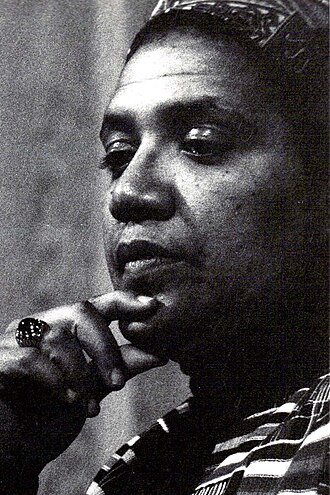
 AuthorAudre Lorde1934–1992
Sister Outsider: Essays and Speeches is a collection of fifteen essays and speeches written by Audre Lorde between 1976 and 1984. Lorde was an American poet, activist and essayist who defined herself through the combination of her identities: Black woman, lesbian, mother, breast cancer survivor and feminist. Published in 1984 by The Crossing Press, the book gathers texts that differ widely from one another, from notes on a 1976 trip to the Soviet Union to reflections on war, imperialism and police brutality, along with essays on violence against women and the need to build coalitions.
The common thread is the defense of difference as a starting point for change, in contrast to the tendency of Western culture to read human differences as simplistic oppositions between good and bad or superior and inferior. Lorde denounces sexism, racism, homophobia, classism and ageism, and argues that these oppressions are complex and interlocking. Faced with the mistrust and fear that divide Black women, lesbians, feminists and white women, she proposes using difference as a catalyst for creative action. The paradoxical title expresses her stance of standing on the line of fire and refusing the safety of remaining within established boundaries.
One of the best-known pieces is "Uses of the Erotic: The Erotic as Power", in which Lorde distinguishes the erotic from the pornographic. For her, the erotic is a source of emotional energy and knowledge, whereas pornography suppresses feeling and emphasizes sensation alone. This distinction leads her to understand sexuality as a form of resistance against a racist, patriarchal and homophobic society. Other texts, such as "The Master's Tools Will Never Dismantle the Master's House", criticize exclusion and tokenism within feminist theory, while "The Uses of Anger" examines how oppressive systems try to deny and blame oppressed communities for their anger.
The book was a considerable commercial success for its publisher and was republished in 2007 with a foreword by the scholar Cheryl Clarke. Over time it has become a key reference in feminist theory and in studies of intersectionality, and it is widely taught at universities. Its contribution to critical social theory lies in articulating, from personal experience, an analysis of how different forms of oppression overlap, and of how poetry, speech and action can be used to transform them.
Themes
Other works by Audre Lorde
- The Cancer Journals 1980
Original Filopedia text based on Wikipedia (es) and Wikipedia (en) and Wikidata.