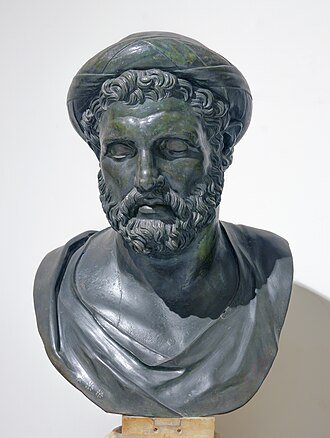
Archytas
429 BC–344 BC · Pythagorean philosopher, mathematician and statesman from Taras
Archytas of Tarentum (c. 430-360 BC, though sources disagree on the exact dates) was a Pythagorean philosopher, mathematician, statesman and general from Tarentum, a Greek colony in southern Italy. He lived in the same period as Plato, who counted him among his friends, and he is regarded as one of the first thinkers to link mathematical knowledge with political life and practical technique. He matters because his work bridges the philosophy that came before Socrates and the mathematics, music and mechanics that flourished later.
He was born in Tarentum, the son of Hestiaeus according to one source and of Mnesagoras according to another. He is presumably said to have been taught by Philolaus, and he taught mathematics to Eudoxus of Cnidus, who in turn taught Menaechmus. The Tarentines elected him strategos for seven years in a row, which broke their own rule against successive terms and shows how much authority he had. He is credited with military successes and with a political reform that made Tarentum one of the wealthiest cities of Magna Graecia. The Seventh Letter, traditionally ascribed to Plato, says he tried to help Plato during his troubles with Dionysius II of Syracuse. He died in a shipwreck off the coast of Apulia.
Only fragments of his writings survive, and just four are generally accepted as genuine. They dealt mainly with music and mathematics. He is credited with an ingenious geometric solution to the problem of doubling the cube, built with moving figures, and with an analysis of proportions and musical intervals. For him, arithmetic, which he called logistic, was the foundation of the sciences, and the right method made discovery feel simple. Unlike Plato, he did not look down on sense experience. He also saw in careful calculation a way to plan a fair division of property that could prevent civil strife, and he argued that one should act by reason rather than be carried away by anger or desire. His thought experiment for the infinity of the universe remains one of the most famous in antiquity.
His influence was considerable. He was among the first to treat arithmetic, geometry, astronomy and music as kindred disciplines, an idea that later shaped the medieval quadrivium. Some ancient and modern writers think he influenced Euclid, although the transmission of his ideas is uncertain.
Key ideas
- Primacy of arithmetic: calculation, or logistic, is the foundation of the sciences, ranking above geometry.
- Methodological optimism: with the right method, scientific knowledge becomes accessible and straightforward.
- From the general to the particular: understanding begins with the nature of the whole before turning to its parts.
- Reason and balance: mathematical proportion could inspire a fair distribution that prevents political violence.
Curiosities
A mechanical dove
He is said to have built a mechanical bird that could fly, although the only ancient mention comes centuries later and is regarded as legendary.
An unburied body
According to Horace, his body lay unburied on the shore until a sailor scattered sand over it.
Teachers and influences
Teachers
- Philolaus 469 BC–389 BC
Pupils
- Eudoxus of Cnidus 407 BC–354 BC
Original Filopedia text based on Wikipedia (es) and Wikipedia (en) and Wikidata.