Eudoxus of Cnidus
407 BC–354 BC · Greek philosopher, astronomer and mathematician
Eudoxus of Cnidus was an ancient Greek philosopher, astronomer, mathematician and physician, born in Cnidus, a city on the southwest coast of what is now Turkey. A student of Plato in the 4th century BC, he is regarded as the father of mathematical astronomy and as one of the greatest mathematicians of antiquity, surpassed only by Archimedes. None of his original works survive; what we know comes from later writers.
The dates of his life are uncertain. The traditional chronology places him between 407 and 354 BC, but many scholars now prefer a birth around 390 BC and a death around 337 BC, since he outlived Plato. He came from a modest background, and his native city was famous for its medical school. He is said to have studied mathematics with Archytas of Tarentum and medicine with Philiston, though the journey to Italy this implies is doubted.
At about twenty-three he went to Athens, drawn by the Socratics. That first stay lasted only two months and probably brought him into contact with Plato. He later spent around sixteen months in Heliopolis, in Egypt, studying astronomy with the priests. Back home he founded a school of philosophy, mathematics and astronomy at Cyzicus. Around 368 BC he returned to Athens and became one of the most prominent figures of the Academy, though the nature of his relationship with Plato is unclear: some sources describe it as hostile, others as cordial.
In Cnidus he took part in public life, and he is said to have drafted the city's new democratic constitution and built an observatory. A controversial tradition has him rivalling Plato as a teacher, but how closely he was tied to the Academy remains uncertain.
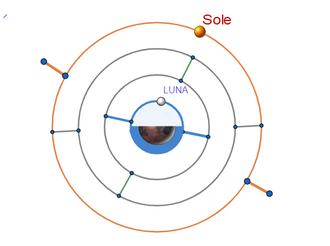
His best-known astronomical achievement is the system of homocentric spheres: nested spheres turning around a fixed Earth at the centre, carrying the Sun, Moon, planets and fixed stars. To account for the retrograde motion of the planets he combined several spheres with tilted axes, producing a figure-eight curve called the hippopede. His model later served as the basis for Aristotle's cosmology.
In mathematics he refined Antiphon's method of exhaustion, a forerunner of integral calculus, and used it to prove that the areas of circles are proportional to the squares of their radii. His greatest contribution was a theory of proportion that handled incommensurable magnitudes without irrational numbers. That theory forms Book V of Euclid's Elements.
Its influence endured: the theory of proportion was revived in the sixteenth century and inspired Dedekind's work on the real numbers.
Key ideas
- Homocentric spheres: a system of nested spheres around a fixed Earth that accounts for the motions of the heavenly bodies.
- Hippopede: a figure-eight curve, produced by combining two spheres, that explains the retrograde motion of the planets.
- Theory of proportion: a definition of equality between ratios that handles incommensurable magnitudes without irrational numbers.
- Method of exhaustion: an approximation method using limits, a forerunner of integral calculus, used to find areas and volumes.
Curiosities
Two months in Athens
According to Diogenes Laertius, during his first stay in Athens he lived in Piraeus and walked each day to and from the lectures he attended.
A large family
Sources credit him with one son, Aristagoras, and three daughters, Actis, Philtis and Delphis.
Teachers and influences
Teachers
Original Filopedia text based on Wikipedia (es) and Wikipedia (en) and Wikidata.