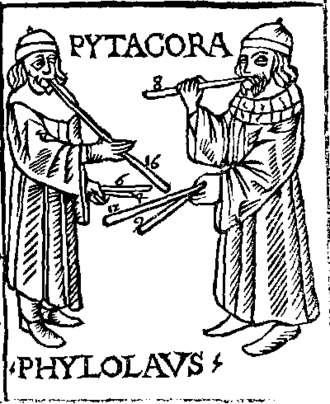
Philolaus
469 BC–389 BC · Pythagorean pre-Socratic philosopher from Magna Graecia
Philolaus was a Pythagorean philosopher born in Magna Graecia, the Greek-settled region of southern Italy, and active between the late fifth and early fourth centuries BC. He is often counted among the most important figures of the Pythagorean school and is usually credited with being one of the first to put its doctrines into writing. His thought, typical of the pre-Socratic period, mixes mathematics, cosmology and music theory, and his name is linked to one of the earliest ideas of a universe in which the Earth does not sit at the centre.
The facts of his life are uncertain. Different sources give Croton, Tarentum or Metapontum as his birthplace, though Croton is considered the most likely. He probably left southern Italy for mainland Greece, perhaps after the Pythagorean meeting-place was burned in the middle of the fifth century BC. He is said to have lived for a time in Heraclea, where he studied under Aresas, and later to have taught at Thebes Simmias and Cebes, who appear in Plato's Phaedo as friends of Socrates. Diogenes Laertius reports that he died in Croton, accused by his fellow citizens of wanting to become a tyrant, but the story is dubious and comes down in a legendary form.
In his cosmology, Philolaus pictured an orderly universe that could be described in numbers. At its centre was not the Earth but a Central Fire, which he called Hestia, and around it moved the Earth, the Moon, the Sun, the five known planets and the sphere of the fixed stars. Tradition adds that he also posited a Counter-Earth, Antichthon, to complete the number of bodies his numerical theory required. His explanation of the Earth's daily rotation, as a turning around a fixed point, also anticipated later ideas. In his philosophy the world arises from the combination of the limiting and the unlimited, joined by harmony, without which unlike things could not form a stable whole.
The surviving record of his writings is complicated. Diogenes Laertius attributes to him a book On Nature, which Plato is said to have acquired and used when writing the Timaeus. Other authors speak of three books, which suggests a single treatise divided into parts: the first on the universe and the second on the nature of numbers. Only fragments survive today, collected and explained by August Boeckh in 1819.
His influence was considerable. Aristotle discussed his Counter-Earth, and in the Renaissance Copernicus acknowledged that Philolaus had earlier proposed a motion of the Earth around a centre. Today he is remembered mainly as a key link between Pythagorean cosmology and the great astronomical theories that followed.
Key ideas
- The limiting and the unlimited: everything that exists results from the combination of a principle that sets limits and one that has none.
- Harmony: the joining of unlike elements produces an ordered cosmos that could not hold together without it.
- Central Fire: the universe revolves around a central fire rather than the Earth, and the Earth itself moves in an orbit.
- Number as essence: numbers are the basis of reality and its order, according to the Pythagorean doctrine he set out.
Curiosities
A much-disputed book
According to Diogenes Laertius, Plato bought a book by Philolaus for a large sum of silver, although the figures differ between versions. The story is not fully trusted.
An invisible earth
Aristotle mentions a Counter-Earth added by Philolaus. Some scholars think Aristotle was actually mocking the idea.
A lunar crater
The lunar crater Philolaus bears his name in his memory.
Teachers and influences
Pupils
- Archytas 429 BC–344 BC
- Xenophilus b. 400 BC
Original Filopedia text based on Wikipedia (es) and Wikipedia (en) and Wikidata.