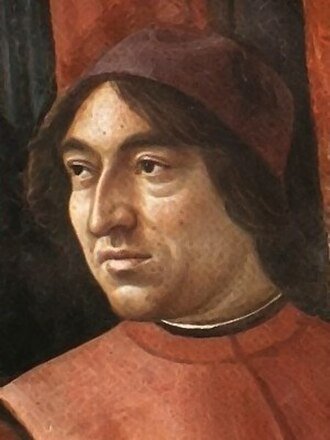
Agnolo Poliziano
1454–1494 · Italian humanist and classical scholar
Angelo Poliziano (Montepulciano, 1454 – Florence, 1494), known in English as Politian, was an Italian humanist, poet and classical scholar of the Florentine Renaissance. He wrote in Latin, Greek and Italian, and his careful work on ancient texts helped move Renaissance Latin away from medieval habits.
His father, a jurist, was murdered for political reasons when Angelo was a boy, and the young man was raised in Florence, where he learned Latin and Greek and began studying philosophy with Marsilio Ficino. Around 1470 he made his name by translating several books of Homer's Iliad into Latin hexameters, which drew the attention of Lorenzo de' Medici. Lorenzo made him tutor to his children and a trusted companion, and later secured him a post at the University of Florence. Among his students were Michelangelo and the English humanist William Grocyn.
As a scholar he turned away from strict imitation of Cicero and favoured a more eclectic model, defending later writers such as Sidonius Apollinaris. He was among the first to collate complete manuscripts and to propose emendations to classical Greek texts. His Italian poetry includes the lyrical drama Orfeo and the unfinished Stanze honouring Giuliano de' Medici.
He never published a complete edition in his lifetime. What survives is a body of notes, extracts and his Miscellanea, printed in 1489. Historians consider it likely that he was homosexual, though this is not certain, and he never married. He died in Florence in 1494, and the causes of his death, long debated, were examined again after forensic tests in 2007.
His legacy lies mainly in modern philology. His Miscellanea influenced scholars of the following century, and his insistence on documentary evidence marked a change in how antiquity was studied, as it began to separate from civic life.
Key works
- Orfeo, an Italian lyrical drama with musical accompaniment, performed at Mantua and based on the myth of Orpheus and Eurydice.
- Stanze per la giostra (1475), an Italian poem in octaves celebrating Giuliano de' Medici's victory in a tournament, left unfinished.
- Manto, a Latin didactic poem written in the 1480s as an introduction to his lectures on Virgil.
- Miscellanea (1489), essays on philology and textual criticism.
Works in Filopedia
- Manto 1480
Curiosities
A famous pupil
Among those who attended his lectures was Michelangelo Buonarroti, according to the sources consulted.
A proposal to the King of Portugal
In 1491 he wrote to King John II of Portugal offering to compose an epic about his maritime achievements. The king replied favourably but never commissioned it, and the epic was written almost a century later by Luís de Camões.
Teachers and influences
Teachers
- Marsilio Ficino 1433–1499
- Cristoforo Landino 1424–1498
Original Filopedia text based on Wikipedia (es) and Wikipedia (en) and Wikidata.