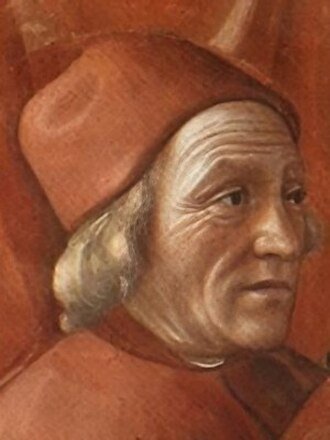
Marsilio Ficino
1433–1499 · Italian Neoplatonist priest, philologist and philosopher of the Renaissance
Marsilio Ficino (Figline Valdarno, 1433 - Careggi, Florence, 1499) was an Italian Catholic priest, philologist, physician and philosopher of the early Renaissance. Under the protection of the Medici, he led the revival of Neoplatonism and presided over the Platonic Academy of Florence, whose influence reached much of the European culture of his age.
The son of a physician in the service of Cosimo de' Medici, he studied medicine at his father's wish, though it never became his real vocation. His surname probably derives from a shortened form of his father's name. Around 1459 Cosimo entrusted him with the new academy, and there he devoted himself to learning Greek and rendering Plato, Plotinus and the Corpus Hermeticum into Latin. His Latin version of Plato's dialogues, published in 1484, was the first complete translation of Plato's work. He was ordained a priest in 1473 and later became a canon of Florence Cathedral.
His own writings include the Platonic Theology on the immortality of souls, De Christiana religione and De Amore, a commentary on the Symposium. His thought rests on Plotinus's metaphysics: the world emanates from God, and the human soul seeks to return to its source. For Ficino, knowing God requires an inner purification, and Christ becomes above all a model of virtue. He also defended an ancient wisdom, the pia philosophia, running from Hermes Trismegistus through Orpheus, Pythagoras and Plato, which he believed found its fulfilment in Christianity. His best-known contribution is the notion of Platonic love: he separated sensual love from spiritual love, understood as a share in Eros, the force that binds the universe and draws creatures toward God.
In De vita libri tres he offered advice on keeping health and vital energy, drawing on astrology and a vision of a living cosmos. These views brought him suspicion of heresy, and in 1489 he was accused before Pope Innocent VIII, who acquitted him. Ficino also changed how melancholy was understood, linking it to the gifted writer and creative mind, an idea that resonated strongly with artists and poets. His influence reached Botticelli, Dürer, Pico della Mirandola and Paracelsus.
He died at the Medici villa of Careggi in 1499. His legacy endured in Renaissance views of love, melancholy and the relationship between philosophy and religion.
Key ideas
- Neoplatonism: the world emanates from God, and the human soul aspires to return to its origin.
- Pia philosophia: an ancient wisdom, from Hermes Trismegistus to Plato, which Ficino believed converged with Christianity.
- Platonic love: a spiritual love that shares in Eros, the force that binds the universe and lifts it toward God.
- Creative melancholy: melancholy understood as a mark of the literary and artistic genius.
Curiosities
A legendary apparition
According to tradition, after his death he was said to have appeared to his friend Michele Mercati to confirm that what they had discussed was true.
The origin of the term
The expression Platonic love first appeared in a letter to Alamanno Donati in 1476.
A bust in the cathedral
In 1521 a bust by Andrea Ferrucci was dedicated to him; it stands in the Cathedral of Santa Maria del Fiore in Florence.
Teachers and influences
Teachers
- Gemistus Pletho 1355–1452
- John Argyropoulos 1415–1480
Pupils
- Agnolo Poliziano 1454–1494
Influenced
- Giordano Bruno 1548–1600
Original Filopedia text based on Wikipedia (es) and Wikipedia (en) and Wikidata.