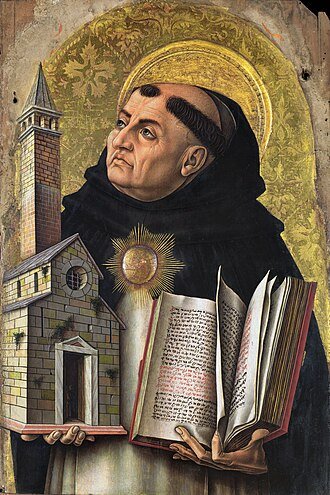
 AuthorThomas Aquinas1225–1274
The Treatise on the Government of Princes, known in Latin as De regno, ad regem Cypri (On Kingship, to the King of Cyprus), is a political treatise written by the Dominican friar Thomas Aquinas between 1265 and 1266. He dedicated it to King Hugh II of Cyprus, who had served as regent of the Kingdom of Jerusalem from the age of five. The work was left unfinished, probably because of the early death of its dedicatee, and Thomas himself broke off writing in Book II, chapter 4.
In the oldest manuscripts the text appears as De regno. Decades later, it is possible, though not certain, that Bartholomew of Lucca, a disciple of Thomas, completed the missing part and wrote Books III and IV. The two parts circulated together under the title De regimine principum, which became the standard name. Modern critical editions, such as the Leonine Edition, prefer De regno, ad regem Cypri in order to separate clearly what belongs to Thomas.
Unlike other writings by the saint, this work defends a strong, nearly absolutist monarchy rather than a mixed regime with aristocratic participation. This stance has been linked to the climate of internal revolts that unsettled Cyprus from 1233 onward. Its intellectual debts include the strong influence of the political thought of Albertus Magnus.
Thomas restricts his subject to monarchical government and attempts to reconcile it with Scripture, classical philosophy and a Christian view of society. Starting from Aristotle's notion that human beings are political animals who gather in communities to pursue the common good, namely meeting material needs and living a virtuous life, he concludes that a single leader is needed to direct the community toward that end. The state thus appears as a divine creation rooted in natural order rather than a result of sin. Yet the legitimacy of power depends on serving the common good and submitting to natural law.
Among forms of government, Thomas holds that rule by one person is the best suited to guide society, since it prevents the particular interests of the masses from distorting its course. He acknowledges that aristocracy and politeia can be legitimate, though less perfect because of their instability. Against these he distinguishes three corruptions: tyranny, a monarchy serving its ruler's own ends; oligarchy, an aristocracy captured by a wealthy elite; and democracy, understood as a politeia degenerating into the dominance of the multitude over those outside it.
Thomas regards tyranny as the worst form of government and seeks ways to prevent it. In principle he rejects armed rebellion and defends political mechanisms through which the people, exercising their public authority, could depose a king who fails in his duties. However, the work was left incomplete and never specified those limits. This position has been read as an early precursor of the right to resist.
Themes
Other works by Thomas Aquinas
Original Filopedia text based on Wikipedia (es) and Wikipedia (en) and Wikidata.