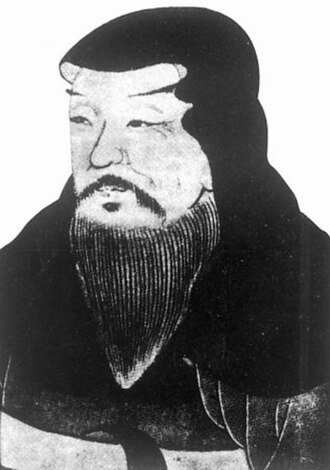
 AuthorXu Shen58–147
The Shuowen Jiezi (说文解字, roughly "Explaining Simple Characters and Analysing Compound Ones") is a Chinese dictionary compiled by the scholar Xu Shen during the Eastern Han dynasty (25–220 CE). Xu finished it around 100 CE, but because the imperial court was unfavourable to scholarship at the time, his son Xu Chong did not present it to Emperor An of Han until 121, together with a memorial.
The work is generally regarded as the first to set out systematically how Chinese writing works, analysing the structure of characters and explaining their origins and methods of composition. Earlier reference works such as the Erya had listed words by semantic fields, but the Shuowen Jiezi introduced a new arrangement: characters were grouped according to the graphical components they shared, known as radicals. This made them far easier to look up, and the principle became the basis of later Chinese dictionaries.
Xu also had practical and political aims. He believed that fixing the meanings of characters in the pre-Han classics would ensure order in government, in keeping with the Confucian doctrine of the rectification of names that dominated Han thinking about language. His analysis focuses on characters in seal script, the standardised form promulgated under the Qin dynasty, and he also records ancient and Zhou-period forms.
The dictionary has a preface and fifteen chapters: fourteen of character entries, and a final chapter containing a postface and an index of section headers. In his postface Xu gives 9,353 character entries plus 1,163 graphic variants. He sorted the lexicon into 540 sections under radicals, some chosen for cosmological reasons or for internal sequence rather than by the logic of modern dictionaries, so that some sections are empty and others hold only one character.
A typical entry gives the seal-script form of the character, a short definition, usually a single synonym, its pronunciation indicated by a homophone, and, for compound characters, an analysis of their semantic and phonetic components. Xu also formulated the theory of the "six principles" of character classification, though only the first four appear in the body of the dictionary.
The original Han text has been lost, and the work survived for centuries through hand-copied manuscripts. Among the scholars who edited and commented on it, Li Yangbing's emendations are much debated, while many Qing-dynasty scholars greatly improved its study. Today it remains a foundational reference for Chinese philology and for the history of writing.
Themes
Original Filopedia text based on Wikipedia (es) and Wikipedia (en) and Wikidata.