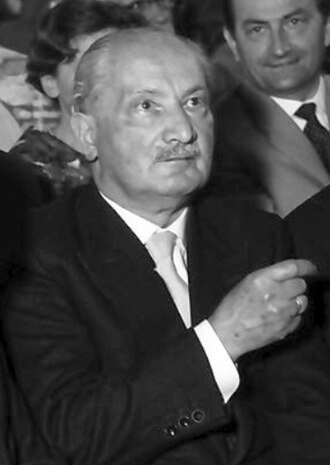
 AuthorMartin Heidegger1889–1976
Being and Time (Sein und Zeit, 1927) is the central work of the German philosopher Martin Heidegger and one of the most influential texts of twentieth-century philosophy. It was published in Halle, drawing on years of lectures and teaching at the universities of Freiburg and Marburg, and was meant to be the first part of a much larger project. As it appeared, the book represents only about a third of that plan; the planned second half, which would have included a critical dismantling of the history of Western philosophy, was never written.
The work's central question is the meaning of being: what it means for something to be, and why there is something rather than nothing. Heidegger takes up this old problem of ontology, first treated by Aristotle, and departs both from a logic based on propositions and from the idea that theoretical knowledge is the most basic relation between human beings and the world. To pursue the question he adopts the phenomenological method inherited from Edmund Husserl, but shifts it: rather than starting from consciousness and intentionality, he starts from existence itself. The human being receives the name Dasein, "being-there," an entity whose essence lies in existing within a world and understanding itself through its possibilities.
The book has two divisions. The first offers a preparatory analysis of Dasein in everyday life: being-in-the-world, practical dealings with equipment, coexistence with others, anxiety, death, and care (Sorge) as the unified structure of existence. The second examines temporality as the horizon of Dasein's being and attempts an interpretation of time grounded in finitude and death. Heidegger distinguishes between inauthentic existence, dominated by "the they" and anonymity, and authentic existence, which takes on one's own finitude and one's own possibilities.
Its reception was enormous. It shaped existentialism in a decisive way, particularly Jean-Paul Sartre, and left its mark on Hans-Georg Gadamer's hermeneutics, Jacques Derrida's deconstruction, Jacques Lacan's psychoanalysis, and the Frankfurt School, although Theodor Adorno sharply criticized it in The Jargon of Authenticity. Its vocabulary, full of neologisms, passed largely into later philosophy. The work also carries a delicate political dimension: Heidegger joined the Nazi Party in 1933, and the dedication to Husserl, who was Jewish, was removed in editions during the Nazi period and restored afterward.
Themes
Other works by Martin Heidegger
Original Filopedia text based on Wikipedia (es) and Wikipedia (en) and Wikidata.