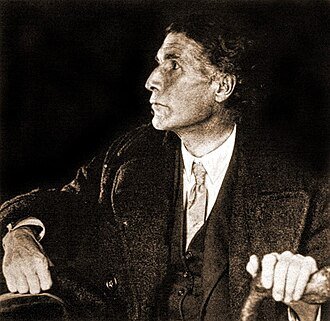
 AuthorJohn Cowper Powys1872–1963
Owen Glendower is a historical novel by John Cowper Powys, first published in America in January 1941 and in Britain in February 1942. It is Powys's ninth novel and the first of two set in medieval Wales; the other is Porius (1951). Powys wrote it after settling in 1935 in Corwen, in North Wales, the land of his ancestors, and it reflects his growing sense of a bardic heritage. For the title he adopted the anglicised form of Owain Glyndŵr's name used by Shakespeare, although within the book he mostly calls him Owen Glyn Dŵr or simply Owen.
The story centres on Owain Glyndŵr's rebellion against King Henry IV, which began on 16 September 1400 at Corwen, when Owen formally assumed the ancestral title of Prince of Powys at his manor house of Glyndyfrdwy. Powys spent nearly four years writing the book, researching it through works such as J. E. Lloyd's study of Glyndŵr and J. H. Wylie's history of England under Henry IV, and visiting places connected with the hero, including Meifod, Mathrafal and Sycharth. He finished the manuscript in December 1939 on the hill fort of Mynydd y Gaer above Corwen, traditionally linked with Glyndŵr's final days.
Publication in Britain proved difficult: the novel was turned down by several publishers before the Bodley Head agreed to issue it, paying Powys a very modest sum. The problems are usually attributed to its considerable length and to wartime paper shortages.
The novel falls into two parts. The first eleven chapters follow Rhisiart ab Owen, a young Oxford student and relation of Owen, from his journey into Wales in 1400 to his captivity at Dinas Brân castle. From the end of chapter XI the viewpoint shifts to Glendower, who becomes the focus for the rest of the book, while the narration takes on an omniscient voice that seems to know almost everything. The book does not cover the whole conflict: it concentrates on a handful of episodes between 1400 and 1405, among them the Battle of Pilleth, the Tripartite Indenture with the Percys and the death of Rhys Gethin, and it ends with a leap to November 1416 and Glyndŵr's death, leaving the intervening years, when he was largely in retreat, largely unexplored.
The cast mixes historical figures, such as the Lollard Walter Brut or Gruffydd Young, with invented characters and episodes drawn from legend or oral tradition. This blend of fact and fiction is central to the book's design.
Its reception has been divided. Its length, expansive style and mixing of registers have been praised as the marks of an ambitious meditation on Welsh identity and criticised as the faults of an uneven narrative. Over the years it has been championed as one of the major English-language historical novels about landscape, memory and belonging.
Themes
Original Filopedia text based on Wikipedia (en) and Wikidata.