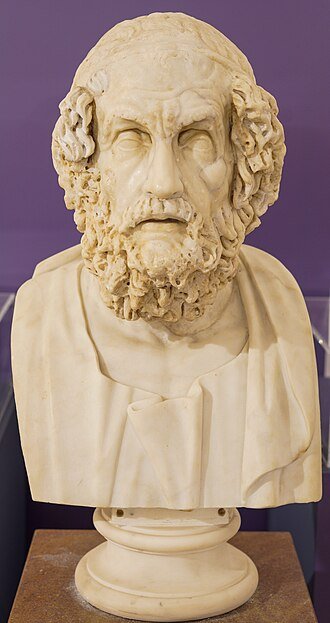
 AuthorHomer900 BC–800 BC
The Odyssey is an ancient Greek epic poem attributed to Homer, composed in twenty-four books. Together with the Iliad, it is one of the oldest surviving works of Western literature and one of the foundations of the Greco-Roman epic tradition. It is generally dated to the 8th or 7th century BC, probably in the Greek settlements on the western coast of Asia Minor, although the exact date and place remain uncertain and scholars do not agree. For a long time the poem circulated orally, recited from memory by bards and rhapsodes who varied it in performance, in the dialects of ancient Greece; the arrival of the alphabet later allowed it to be written down.
The work tells of the return home of Odysseus, king of Ithaca, after the Trojan War. His journey back lasts ten years, during which he faces monsters, gods and perils of every kind, while in his palace his son Telemachus and his wife Penelope must endure a crowd of suitors who consume the household's wealth. The poem marks the shift from epics of war deeds to the nostos, the journey of return. It is usually divided into three parts: the Telemachy (books I to IV), Odysseus's wanderings and return (books V to XII), and his revenge in Ithaca (books XIII to XXIV). It begins in medias res, with the hero already near the end of his ordeal, and recovers earlier events through Odysseus's own accounts.
The hero's chief weapon is metis, cunning, which lets him escape desperate situations through disguises, deceptive speeches and stratagems. Its reception was vast from antiquity onward: for centuries it formed part of education in the Greek world and helped shape a shared pan-Hellenic cultural identity. It remains one of the most influential works of the Western canon, and its protagonist has inspired countless adaptations across literature, theatre, film and other media.
Themes
Books to read
- The Odyssey Rendered into English prose for the use of those who cannot read the original EnglishEPUB 372 KBRead online
- The Odyssey EnglishEPUB 398 KBRead online
- The Odyssey of Homer EnglishEPUB 388 KBRead online
- The Odysseys of Homer, together with the shorter poems EnglishEPUB 561 KBRead online
Other works by Homer
Original Filopedia text based on Wikipedia (es) and Wikipedia (en) and Wikidata.