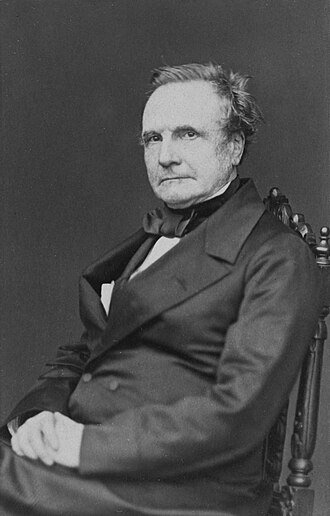
 AuthorCharles Babbage1791–1871
The Ninth Bridgewater Treatise was published in 1837 by the mathematician and inventor Charles Babbage as a response to the eight Bridgewater Treatises, which had been commissioned by the Earl of Bridgewater, Francis Henry Egerton, to lend scientific support to belief in the existence of God. Babbage had not been invited to take part in the series, so his book is an unauthorised continuation that shares the same aim of reconciling science and religion.
The book responds directly to a remark by William Whewell, quoted as an epigraph on the title page, in which Whewell dismissed mechanical philosophers and mathematicians as irrelevant to discussions of the universe. Babbage argued the opposite: his experience programming the analytical engine, an early computer, allowed him to conceive of a God capable of designing a complex, programmed world.
The work is a piece of natural theology. Its central thesis is that God possessed the omnipotence and foresight to create the world as a divine legislator, so that apparent adaptations and deviations in nature were encoded into it from the beginning. Babbage also addresses the relationship between Scripture and science, holding that the Book of Genesis should not be read literally on geological questions, and he devotes a chapter to David Hume, redefining miracles not as violations of natural law but as the exact fulfilment of far more extensive laws.
Babbage further proposes that the material world works as a record that preserves every sound and deed, an image that scholars have linked to motifs in Dickens and Poe. His description of the difference engine in the chapter on miracles has also been regarded by some as an antecedent of evolutionary simulation models. Natural theology of this kind was common until Darwin's work on evolution.
Themes
Original Filopedia text based on Wikipedia (en) and Wikidata.