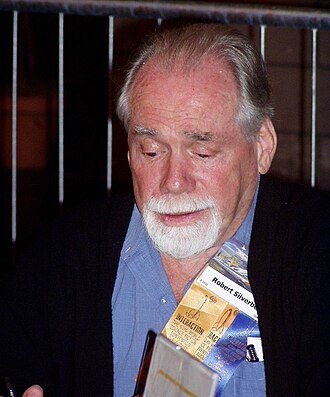
 AuthorRobert Silverbergb. 1935
Dying Inside is a 1972 science fiction novel by the American writer Robert Silverberg. It first appeared as a two-part serial in Galaxy, in the July–August and September–October 1972 issues, and was soon published in book form by Charles Scribner's Sons. It belongs to Silverberg's late-1960s and early-1970s shift toward more literary, psychologically focused science fiction, a move often linked to the American New Wave.
The protagonist is David Selig, a forty-one-year-old man living alone in New York City. Since childhood he has been able to read other people's minds, but that ability is slowly fading. Selig earns a living writing term papers for students at Columbia University, work his telepathy once made easy. As the power weakens, he begins to notice long silences where other people's thoughts used to be. The novel does not treat telepathy as a heroic gift or an adventure device. It uses it to explore isolation, aging, sexuality, identity, and the difficulty of ordinary human connection.
The narrative alternates between Selig's present and his past: the discovery of his gift in childhood, his years of hiding it at school, his troubled relationship with his adopted sister Judith, and his meeting with Tom Nyquist, another mind-reader who has turned the same faculty to financial advantage. His romances with Toni Huxley and Kitty Holstein show his limits. The first ends after an experience that overwhelms him; the second, whose mind is closed to him, draws him into an obsession that ultimately drives her away. In the final part he faces the near-total loss of his ability, and the book offers no restoration of what he has lost.
Its early reception was mixed. Some reviewers praised the prose, characterization, and maturity of the book, while others faulted its introspection, its sexual material, and its uncertain place between science fiction and mainstream literary fiction. It struggled commercially at first. Its reputation has since grown, and it is now regarded as one of Silverberg's major works and a significant example of early-1970s American science fiction. It was nominated for the Nebula Award for Best Novel and was a finalist for the Hugo Award.
Themes
Other works by Robert Silverberg
Original Filopedia text based on Wikipedia (es) and Wikipedia (en) and Wikidata.