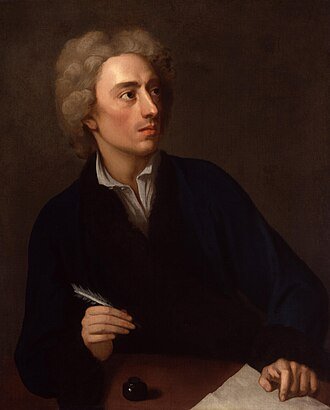
 AuthorAlexander Pope1688–1744
Messiah is a poem by Alexander Pope, published in 1712, which Samuel Johnson translated into Latin in December 1728. Johnson's version, consisting of 119 lines of Latin verse, was the first of his poems to be published. According to the accounts of his biographers, he completed the whole translation in two days at the request of his tutor William Jorden, who was impressed by his skill at Latin verse and set it as a Christmas exercise at Pembroke College, Oxford.
Pope's original deals with Virgil's Fourth Eclogue, which had long been read as a prophecy of the birth of Christ. Pope combines that reading with Isaiah's prophecy of the Messiah, using wording that constantly echoes Virgil. Johnson's translation relies more directly on Virgil and incorporates more of the Eclogue's own language.
The work was well received among Oxford students, and John Husbands's collection Miscellany of Poems (1731) included a list of subscribers that featured half of the enrolled students at Pembroke. Yet the success did not bring the material reward Johnson had hoped for. According to Sir John Hawkins, Pope praised the version by saying he could not tell whether it was the original; Johnson's friend John Taylor downplayed this as mere politeness, since Pope claimed to have seen it before and said nothing more. Because Johnson's father, a bookseller, had printed the translation before Johnson sent a copy to Pope, Pope's remark may have referred to that earlier edition, and Johnson was very angry with his father over it. In the twentieth century, Walter Jackson Bate highlighted the poem as an early and notable demonstration of Johnson's ability as a writer.
Themes
Other works by Alexander Pope
- An Essay on Criticism 1711
- The Rape of the Lock 1712
- Eloisa to Abelard 1717
Original Filopedia text based on Wikipedia (en) and Wikidata.