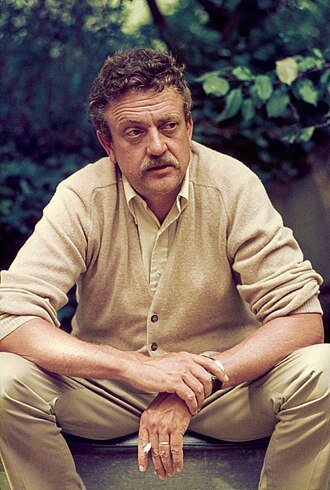
 AuthorKurt Vonnegut1922–2007
Slaughterhouse-Five, whose full alternative title is The Children's Crusade, is a 1969 novel by Kurt Vonnegut. It is considered his most important work and combines an anti-war message with elements of science fiction, satire and irony. Its protagonist, Billy Pilgrim, is an optometrist from Ilium, New York, who remembers and relives episodes of his life as an American soldier during the Second World War. Vonnegut himself was a prisoner of war in Dresden and survived the Allied firebombing of the city in February 1945, and the novel draws heavily on that experience, with Pilgrim serving as his alter ego.
The story centers on Billy's capture by the German army and his confinement, along with other prisoners, in a former slaughterhouse converted into a prison, which gives the book its title. From there the prisoners survive the bombing of Dresden, which destroyed the city and killed a vast number of civilians. The narrative does not follow a chronological order: Billy moves back and forth between moments of his life, from the war to his youth, his marriage and his old age, a structure that reflects his psychological state and the trauma he carries. According to the novel, Billy has been abducted by the Tralfamadorians, inhabitants of a distant planet who perceive time in four dimensions and for whom every moment of life exists at once. This fatalistic outlook leads Billy to accept death with resignation, and the phrase "so it goes" recurs throughout the book whenever someone dies.
Vonnegut employs an unreliable narrator who repeatedly interrupts the story to speak about himself and about the process of writing the book. Through irony, dark humor, the absurd and the surreal, the novel condemns the brutality of war, the senselessness of violence and the fragility of human beings, who in the book appear insignificant even in the eyes of other species. It also criticizes militarism and blind patriotism, and readers at the time took it as a reflection on the Vietnam War, which was ongoing when it was published.
The novel was widely acclaimed and has become one of the most influential anti-war works in twentieth-century American literature. It was adapted to film in 1972 by George Roy Hill, with Michael Sacks, Ron Leibman and Valerie Perrine in the leading roles, and the film won the Grand Jury Prize at the Cannes Film Festival. Its title and style have also influenced later works about war and the memory of trauma.
Themes
Other works by Kurt Vonnegut
- Cat's Cradle 1963
- Breakfast of Champions 1973
Original Filopedia text based on Wikipedia (es) and Wikipedia (en) and Wikidata.