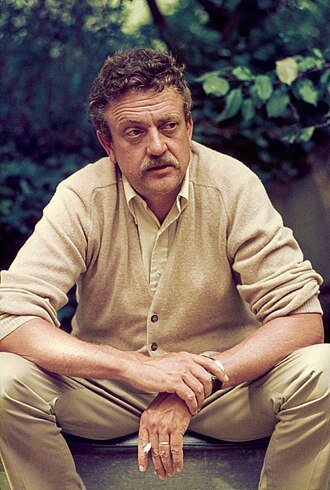
 AuthorKurt Vonnegut1922–2007
Cat's Cradle is Kurt Vonnegut's fourth novel, first published in the United States on March 18, 1963. It is a satirical postmodern work with science fiction elements that explores and mocks questions of science, technology, the purpose of religion and the arms race, often through morbid humor. The novel was nominated for the Hugo Award for Best Novel in 1964.
The narrator, a professional writer who introduces himself as "Jonah," is preparing a book about what people were doing on the day of the atomic bombing of Hiroshima. To research it, he seeks out the associates of Felix Hoenikker, one of the creators of the atomic bomb and a Nobel-winning physicist, and learns of an invented substance called ice-nine, a form of water that is solid at room temperature and freezes any liquid water it touches. Hoenikker's three adult children still hold samples of it. A magazine assignment then takes the narrator to the fictional Caribbean island of San Lorenzo, one of the poorest countries on Earth, where he encounters Bokononism, a semi-parodic religion founded by Bokonon, a former island leader. It combines irreverent and cynical observations about life with an emphasis on coincidence and serendipity, and its sacred text, The Books of Bokonon, is woven through the book.
The plot moves toward a catastrophic ending. Hoenikker's children, competing for power, vie to succeed the ailing dictator, and ice-nine ends up freezing the world's oceans, unleashing violent tornadoes across the Earth. The book is also an allegory of the nuclear threat of the Cold War, especially the Cuban Missile Crisis of 1962, whose Caribbean setting is reflected in the fiction. Vonnegut's style relies on irony, morbid humor and parody, and despite its brevity the novel is divided into 127 short chapters, which the author himself compared to the tiles of a mosaic, each one a joke.
The book grows out of Vonnegut's experience after World War II working in public relations for the General Electric research company, where he interviewed scientists who, in his view, seemed indifferent to how their discoveries might be used. The chemist Irving Langmuir inspired the character of Hoenikker, and the idea of an ice stable at room temperature came from a conversation between Langmuir and H. G. Wells that reached Vonnegut through his brother. Although ice-nine has no real counterpart among known forms of ice, the novel has become one of the most influential works of postwar American literature, and its blend of black humor, social criticism and reflection on free will places it among Vonnegut's essential books.
Themes
Other works by Kurt Vonnegut
Original Filopedia text based on Wikipedia (en) and Wikidata.