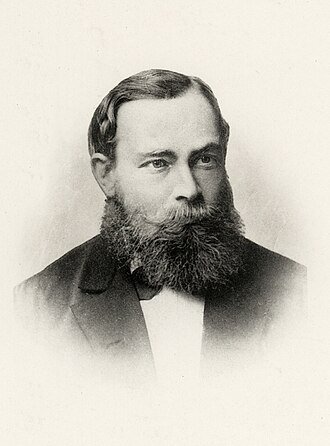
 AuthorGottlob Frege1848–1925
The Foundations of Arithmetic is a book by Gottlob Frege, published in 1884, which investigates the philosophical foundations of arithmetic. Frege takes up a question inherited from Kant: how numbers are given to us if we have no idea or intuition of them. To answer it he relies on a context principle, according to which words have meaning only within the context of a proposition, and he seeks to define the sense of propositions in which number words occur. A problem traditionally solved along idealist lines is thus recast in linguistic terms.
The book opens with a critique of psychologistic accounts of mathematics, which make numbers depend on the subjective thoughts of those who think about them. Frege insists that mathematics is objective and that logic, and in his view mathematics as well, explains necessary facts, whereas psychology studies thought processes in individual minds. He also engages with Immanuel Kant, whom he greatly admires, but whose claim that arithmetical truths are synthetic he rejects: Frege holds that arithmetic is analytic a priori, while conceding that geometry is synthetic a priori. Similarly, he criticizes John Stuart Mill's empiricism, particularly the idea that numbers correspond to ways of dividing collections of objects, which he argues cannot account for calculations with large numbers or for the concept of zero.
To develop his own view, Frege distinguishes particular numerical statements, such as 1 + 1 = 2, from general ones, such as a + b = b + a, and concludes that a definition of the concept of number itself is required. He shows that numbers function in natural language as adjectives, yet argues that they are objects, so that numerical statements are in fact assertions about concepts. He proposes defining numbers as extensions of concepts, though he voices some hesitation about that definition. The book also contains his well-known Julius Caesar problem: a proper theory should explain why Julius Caesar is not a number.
The work was not well received or widely read when it appeared, but it drew the attention of Bertrand Russell and Ludwig Wittgenstein, both strongly influenced by Frege. Its importance is considerable: it shaped Frege's later logicist program and the foundations of mathematics, influenced works such as Principia Mathematica, and is regarded as a starting point of analytic philosophy and of the philosophy of mathematics. Russell later found a serious flaw in Frege's Basic Law V, known as Russell's paradox, which was resolved by axiomatic set theory.
Themes
Other works by Gottlob Frege
- Begriffsschrift 1879
Original Filopedia text based on Wikipedia (es) and Wikipedia (en) and Wikidata.