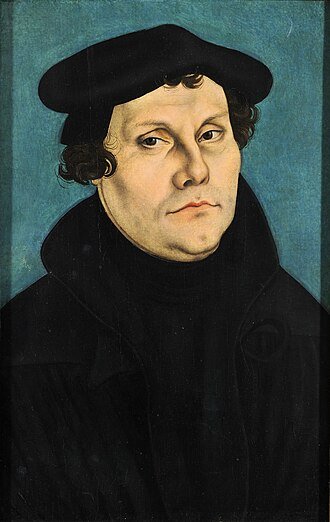
 AuthorMartin Luther1483–1546
The Ninety-five Theses, whose full Latin title is Disputatio pro declaratione virtutis indulgentiarum (Disputation for the Clarification of the Power of Indulgences), are a series of propositions drafted by Martin Luther in 1517, when he was a professor of theology at the University of Wittenberg and a town preacher. They were presented as points for academic debate, though they came to be read as the starting point of the Protestant Reformation, a split within the Catholic Church that profoundly reshaped European history.
The context was a system of salvation in which, after confessing a sin and receiving forgiveness, the believer could still be liable for a temporal punishment that had to be satisfied during life through works of mercy or, failing that, in purgatory. Indulgences could reduce that punishment. In practice, the sale of plenary indulgences, offered on behalf of people supposedly held in purgatory, had become a source of income for the clergy and church authorities. In 1517 the campaign of the friar Johann Tetzel to fund St. Peter's Basilica in Rome, whose preaching reached towns near Wittenberg, prompted Luther to study the matter closely and draft his theses.
The work argues that the repentance Christ demands is an inner, continuing process rather than a mere sacramental confession. Luther holds that the pope can only remit the penalties he himself imposes, not the guilt of sin, and he rejects the idea that paying for an indulgence immediately frees a deceased loved one from purgatory. He also denounces indulgences for producing false security, discouraging true repentance, and diverting the faithful from charity toward the poor, which he regards as far more valuable. Toward the end he questions the doctrine of the treasury of merits on which the practice rested.
The theses, dated 31 October 1517 when sent with a letter to Archbishop Albert of Brandenburg, spread rapidly thanks to the printing press, being translated and reprinted throughout the Holy Roman Empire and the rest of Europe. They provoked a fierce pamphlet war and, within a short time, a heresy trial that ended in Luther's excommunication in 1521. 31 October is now commemorated as Reformation Day. Luther himself, however, did not regard indulgences as the most decisive issue; the deeper doctrinal disagreements came later, and he never saw the publication of these theses as the moment when his beliefs parted from those of the Holy See.
Themes
Original Filopedia text based on Wikipedia (es) and Wikipedia (en) and Wikidata.