The Elementary Forms of Religious Life
sociological treatise on religion · 1912
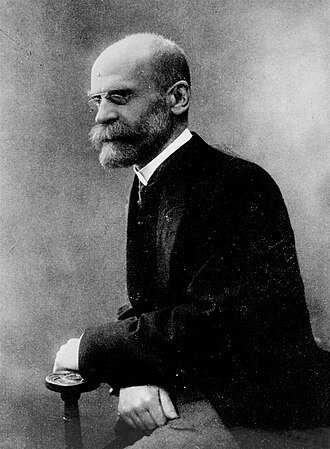 AuthorÉmile Durkheim1858–1917
The Elementary Forms of Religious Life is a book by the French sociologist Émile Durkheim, published in 1912. Durkheim conceived it as a study of religion as a social phenomenon, rather than as a matter of revelation or individual psychology. He took as his basis the totemism of Aboriginal societies in Australia, which he regarded as the simplest and most accessible form of religion then known.
Its central claim is that what each clan revered as a sacred power, in the figure of an animal or a plant, was in fact society itself. Durkheim argues that communal life generates a feeling of security and strength, which people project onto objects in their surroundings, attributing to them superhuman powers. Religion thus arises from collective experience, and its essential element is the distinction between the sacred and the profane, which he held to be the only notion shared by all religions.
In the book, Durkheim defines religion as a unified system of beliefs and practices relating to sacred things, which unites those who share them into a single moral community. He also examines other cases, such as the rain dances of the Pueblo Indians and certain hallucinatory experiences induced by intoxicants, to show the social basis of religious experience. The work had a lasting influence on anthropology, the sociology of religion, and the social sciences that followed.
Themes
Books to read
- The Elementary Forms of the Religious Life EnglishGutenberg
Other works by Émile Durkheim
Original Filopedia text based on Wikipedia (es) and Wikipedia (en) and Wikidata.