The Division of Labour in Society
doctoral dissertation (sociological treatise) · 1893
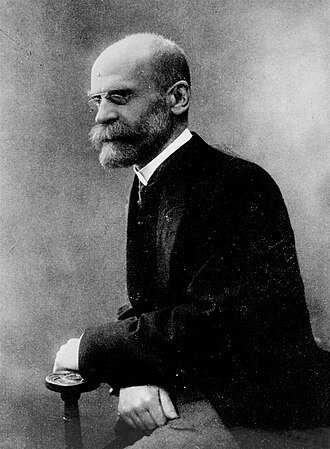 AuthorÉmile Durkheim1858–1917
The Division of Labour in Society is the doctoral dissertation of the French sociologist Émile Durkheim, published in 1893. It is one of the foundational works of modern sociology and proved highly influential in shaping sociological theory and method, drawing in part on the ideas of Auguste Comte.
Its central argument is that social order is maintained in different ways depending on the type of society. Durkheim distinguishes two forms of solidarity: mechanical, characteristic of "primitive" societies, in which individuals think and act alike and share a strong collective conscience; and organic, characteristic of advanced industrial societies, where specialised labour makes individuals mutually dependent. In the first case, crime is an offence against clearly defined collective sentiments, and law is chiefly repressive and penal. In the second, law is more restitutive than punitive, aiming to repair damaged relations rather than punish excessively. Durkheim holds that moral and economic regulation arise naturally in response to the division of labour, allowing people to settle their differences peacefully.
Durkheim warns that the transition from one kind of society to the other may cause disorder, crisis and anomie, though once the advanced stage is reached society grows stronger and more stable. Unlike Karl Marx, he does not foresee a different society emerging from the industrial capitalist division of labour; he regards conflict and chaos as pathologies of modern society, whereas Marx emphasises class conflict.
Themes
Other works by Émile Durkheim
Original Filopedia text based on Wikipedia (es) and Wikipedia (en) and Wikidata.