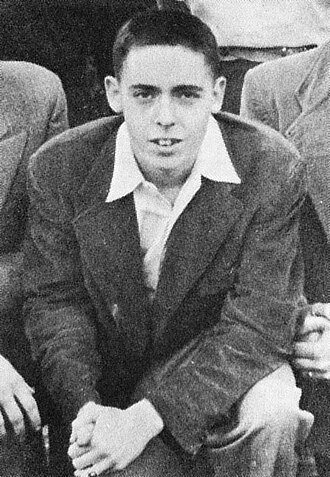
 AuthorThomas Pynchonb. 1937
The Crying of Lot 49 is a novel by the American writer Thomas Pynchon, published in 1966. It is the shortest of his books and is often cited as a key example of postmodern fiction. Its protagonist, Oedipa Maas, leads a comfortable but unfulfilling life in a village in northern California, with her husband Mucho, an aimless radio disc jockey, and her sessions with a German psychotherapist who prescribes LSD to his patients.
One day Oedipa learns of the death of her former lover, Pierce Inverarity, a wealthy Los Angeles real-estate mogul, who has named her co-executor of his estate. Travelling to San Narciso to deal with the estate's lawyer, Metzger, with whom she begins an affair, she starts to come across clues pointing to a supposed underground postal system, the Tristero. The symbol of a muted post horn turns up in bar toilets, graffiti and stamps from Inverarity's collection, and in a Jacobean play, The Courier's Tragedy, the word "Tristero" appears in a line that its director, Randolph Driblette, seems to have inserted on purpose.
The novel follows Oedipa's search through a web of cults, stamp enthusiasts, scholars of Elizabethan theatre and fringe figures. Every discovery seems to confirm a conspiracy and, at the same time, to dissolve it into coincidence. Pynchon presents a conspiracy plot that is never resolved: the book ends with Oedipa about to attend an auction where a representative of the Tristero might appear, without the reader or Oedipa knowing whether the organisation exists, whether everything is a joke arranged by Inverarity, or whether it is all a hallucination.
The work is built on dense prose full of historical, literary and scientific references, ranging from the history of European postal services to the physics of Maxwell's demon. Its structure rests on an unresolved mystery and on reflection about communication, paranoia and the meaning of signs. On its appearance it received mixed reviews, with many readers comparing it unfavourably with V., his first novel. Its reputation has grown over the years, and Time magazine included it among the best hundred English-language novels published between 1923 and 2005.
Themes
Other works by Thomas Pynchon
- V. 1963
- Gravity's Rainbow 1973
- Vineland 1990
- Mason & Dixon 1997
- Against the Day 2006
- Inherent Vice 2009
- Bleeding Edge 2013
Original Filopedia text based on Wikipedia (es) and Wikipedia (en) and Wikidata.