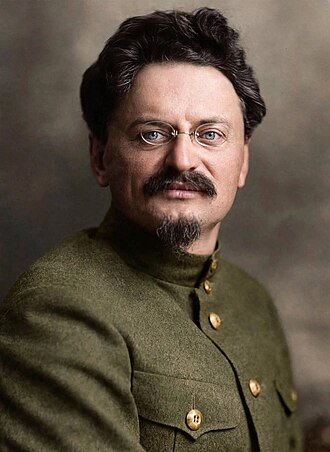
 AuthorLeon Trotsky1879–1940
The Revolution Betrayed is a book written by Leon Trotsky in 1936, during his exile in Norway, and published that same year. Its subtitle, "What Is the Soviet Union and Where Is It Going?", states the author's aim: to analyse the nature of the regime that emerged after Lenin's death in 1924 and to predict its development. It is regarded as Trotsky's principal work on Stalinism and socialist democracy, and as one of his most systematic texts. The original Spanish edition was prepared by Victor Serge, and the most widely available English translation is by Max Eastman.
The book opens by acknowledging the economic advances of the USSR since 1924, including growth in electrical power, agriculture and industry. From there Trotsky examines the limits of that progress. Several chapters address the "zigzags" of Communist Party policy, which he attributes to the absence of democracy: abrupt reversals on agriculture and industry, forced collectivization and accelerated industrialization, which he branded "economic adventurism". He also criticizes the Stakhanovite movement and the shock brigades as unproductive.
The theoretical core of the work is his analysis of the "Soviet Thermidor", a reference to the conservative phase of the French Revolution. He argues that the ruling stratum is neither capitalist nor fully proletarian, but a bureaucratic layer that grew out of the depoliticization of the working class and the inheritance of the Tsarist apparatus. He compares Stalinism to Bonapartism and holds that, just as a planned economy requires democracy as the human body requires oxygen, the absence of freedom would lead to stagnation. He completes the analysis with observations on everyday life, inequality, and the conservative turn in policy toward women and the family.
The book proposes a political revolution that would overthrow the Stalinist dictatorship without destroying the economic gains of planning, restoring criticism, democracy in the trade unions and a plurality of Soviet parties. Trotsky finished it just before the first of the great Moscow trials, and added a postscript presenting it as an advance exposure of the regime's "deliberate mystification". Historians such as Baruch Knei-Paz regard it as his central work on Stalinism, and it remains a key reference in debates over the Soviet bureaucracy.
Themes
Other works by Leon Trotsky
- My Life 1930
- The Permanent Revolution 1931
Original Filopedia text based on Wikipedia (en) and Wikidata.