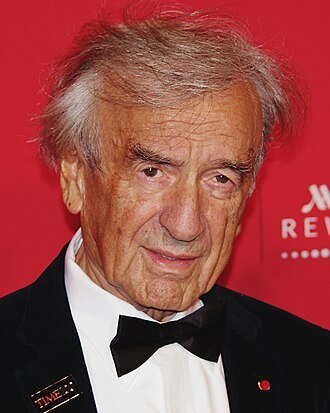
 AuthorElie Wiesel1928–2016
Night is an autobiographical account by Elie Wiesel of his experience alongside his father in the Nazi concentration camps of Auschwitz and Buchenwald between 1944 and 1945, in the final phase of the Second World War. Wiesel wrote it after the war. After ten years of silence about what he had lived through, and having lost his faith in God and in humanity, he completed in 1954 an 862-page manuscript in Yiddish. It was condensed to 245 pages and published in Argentina in 1956 as Un di velt hot geshvign («And the World Was Silent»). The novelist François Mauriac helped him find a French publisher, and in 1958 Les Éditions de Minuit issued a 178-page version titled La Nuit, which appeared in English in 1960 as Night. Critics have noted that this pruning turned an angry historical testimony into a work of considerable literary force.
The book opens in Sighet, a small town in the Carpathian mountains of northern Transylvania, where Wiesel lived with his parents and sisters in a community of Orthodox Jews. Before the deportations, the narrator, Eliezer, a teenager who studies the Talmud and discusses the Kabbalah with Moshe the Beadle, the synagogue caretaker, hears Moshe's account of his expulsion and return, in which he describes killings he had witnessed and that no one wanted to believe. Restrictions follow, then the ghetto, the deportations in cattle wagons and the arrival at Auschwitz, where selection separates Eliezer and his father from his mother and sisters, who are sent to the gas chambers.
The heart of the narrative is the reversal of the father–son relationship. As the father declines into helplessness, Eliezer becomes his caregiver, but also someone who feels resentment and guilt, at times wishing to be free of that burden. Wiesel writes in short, fragmented sentences with frequent shifts of point of view, a style he linked to the chroniclers of the ghettos, where everything had to be said quickly. The father dies in January 1945, shortly before the American army liberated Buchenwald in April of that year, and his son could do nothing to prevent it.
The book is the first volume of a trilogy completed by Dawn and Day, in which Wiesel traces the passage from darkness to light, following the Jewish tradition that begins each day at nightfall. For its testimony on the death of God, the collapse of values and the moral abyss of the Holocaust, Night has become one of the foundational works of Holocaust literature, alongside Primo Levi's If This Is a Man and The Diary of Anne Frank, and it has been translated into dozens of languages. Wiesel regarded it as his testimony, though scholars have pointed out that it is not entirely unadorned.
Themes
Original Filopedia text based on Wikipedia (es) and Wikipedia (en) and Wikidata.