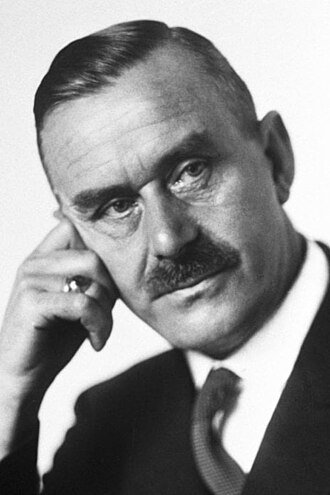
 AuthorThomas Mann1875–1955
The Magic Mountain (Der Zauberberg, in German) is a novel by Thomas Mann published in 1924 and regarded as his most important work. Mann began conceiving it in 1912, after visiting his wife, Katia, who had been admitted to the Wald Sanatorium in Davos, in the Swiss Alps, on suspicion of tuberculosis. He first planned a short novel, a kind of humorous counterpart to Death in Venice, but the project grew into a much longer work. The outbreak of the First World War interrupted it, and the author's political stance changed in the course of writing, from supporting German militarism to backing the Weimar Republic, a shift that left its mark on the text.
The action takes place at the Berghof sanatorium, more than 1,600 metres above sea level. Hans Castorp, a twenty-three-year-old shipbuilding engineer from Hamburg, arrives in 1907 to visit his cousin Joachim Ziemssen, who is being treated for tuberculosis. He intends to stay only three weeks, but the chief physician, Dr Behrens, detects signs of illness in him and persuades him to prolong his stay. Castorp ends up remaining seven years in this isolated world with its own rhythms, where time seems to stretch and blur. There he meets figures embodying opposing currents of thought: Lodovico Settembrini, an Italian humanist who champions reason, progress and democracy, and Leo Naphta, a radical Jewish Jesuit who advocates a communist-style totalitarianism. The two compete for the protagonist's intellectual education. They are joined by the Dutchman Peeperkorn, of Dionysian temperament, and by Claudia Chauchat, the object of Castorp's love, whose presence recalls an early youthful romance.
The novel follows the pattern of the Bildungsroman, or novel of formation, but departs from it in its ending: instead of a mature young man integrated into society, Castorp returns to the lowlands and enlists as one soldier among millions in the war, where his death seems likely. Its reception has been wide, and the book is read as a panorama of the European bourgeois world before 1914 and as an exploration of illness, death, time and the ideological tensions of its age.
Themes
Other works by Thomas Mann
- Buddenbrooks 1901
- Tonio Kröger 1903
- Death in Venice 1912
- Reflections of an Unpolitical Man 1918
- Mario and the Magician 1930
- Lotte in Weimar 1939
- Joseph and His Brothers 1943
- Doctor Faustus 1947
- The Holy Sinner 1951
- The Black Swan 1953
- Confessions of Felix Krull 1954
Original Filopedia text based on Wikipedia (es) and Wikipedia (en) and Wikidata.